

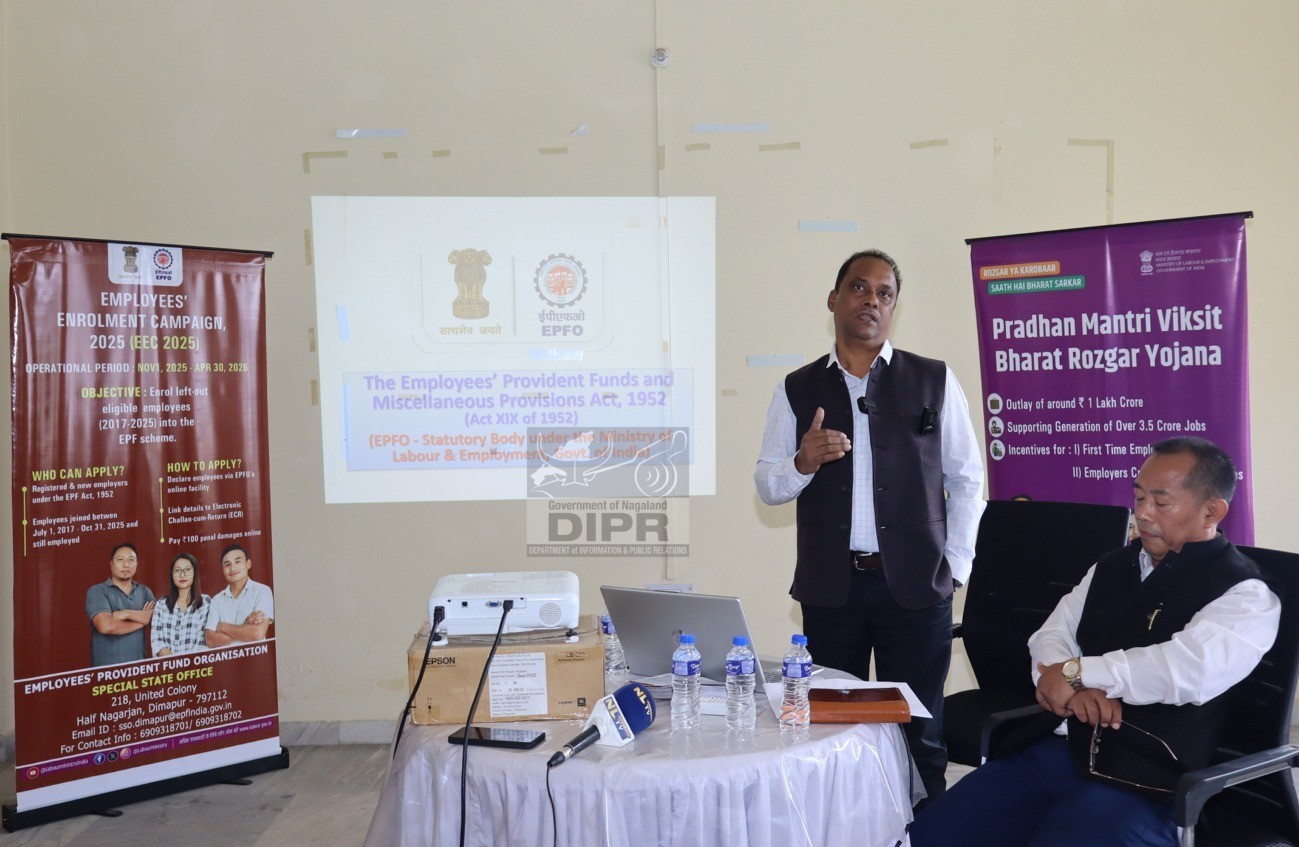
The Department of Labour, in association with the Employees’ Provident Fund Organisation (EPFO) under the Ministry of Labour & Employment, Government of India, organised an awareness camp on Employees’ Provident Fund (EPF) on 24th March 2026, at the office of the Assistant Labour Commissioner, Dimapur.
The campaign, being implemented from November 1, 2025 to April 30, 2026, provides a special six-month window for employers to regularise past non-compliance and enrol left-out eligible employees under the Employees’ Provident Fund (EPF) scheme.
Regional P.F Commissioner, Special State Officer, Dimapur, Samuel Das, informed that employers across establishments can declare employees who joined between July 1, 2017 and October 31, 2025 but were not enrolled earlier. The initiative seeks to strengthen social security by ensuring financial protection and stability for employees and their families. He briefed on the benefits of the Pradhan Mantri Viksit Bharat Rozgar Yojana, which aims to boost employment generation across the country. The scheme, with an outlay of around ₹1 lakh crore, is expected to support the creation of over 3.5 crore jobs and offers incentives for first-time employees as well as employers generating additional employment. He informed that the EPFO office in Dimapur extends assistance on EPF-related matters and facilitates smooth implementation of schemes across Nagaland.
He also highlighted the responsibilities of employers, stating that dues must be remitted before the 15th of every month through ECR, and delays would attract penal charges. Employers were instructed to ensure registration under PM-VBRY, assist employees and their families in filing claims, and carry out all PF-related transactions through official online portals.
Further, employers were directed to enroll all eligible employees, including those engaged through contractors, and ensure compliance by cross-checking wage payments with ECR filings. Updating contractor details, furnishing Form 5A, registering digital signatures, and approving employee KYC were also stressed.
He also highlighted on the Employee Enrolment Scheme 2025 (effective from November 1, 2025), encouraging employers to voluntarily declare and enroll eligible employees. The scheme offers waiver of employee contribution for certain eligible cases and allows participation of establishments under specific conditions with nominal penal charges. Duty of employees were also highlighted, urging them to regularly track their PF accumulations, activate their UAN, and avoid duplication by merging multiple UANs. Employees were advised to complete KYC seeding with Aadhaar, PAN, and bank details, and to file e-nominations.
In conclusion, he emphasis on EPFO’s fully digital, transparent, and efficient service delivery system, including online claims, grievance redressal, and digital life certificate submission, ensuring improved accessibility and social security coverage for workers.
Delivering the welcome address, Deputy Labour Commissioner, Thungpemo Lotha, highlighted the significance of social security schemes such as the Employees’ Provident Fund, stating that they play a crucial role in ensuring financial protection and stability for employees and their families. He also pointed out that many workers and employers are still not fully aware of the benefits under the EPFO, emphasizing the need for such programmes to promote awareness and encourage proper implementation of these schemes.
The session covered major provisions under the Employees’ Provident Funds & Miscellaneous Provisions Act, 1952, including the EPF Scheme (1952), Employees’ Pension Scheme (1995), and Employees’ Deposit Linked Insurance Scheme (1976). Detailed explanations on contribution rates, eligibility, pension benefits, insurance coverage, and withdrawal provisions were provided.
In addition, emphasis was laid on digital initiatives introduced by EPFO for employers. These include online registration of establishments (OLRE), online remittance of dues through Electronic Challan-cum-Return (ECR), allotment of Universal Account Numbers (UAN), e-KYC seeding, and e-sign approval of member data under the centralized IT-enabled system.
(Tovikali, IA, Dimapur)


