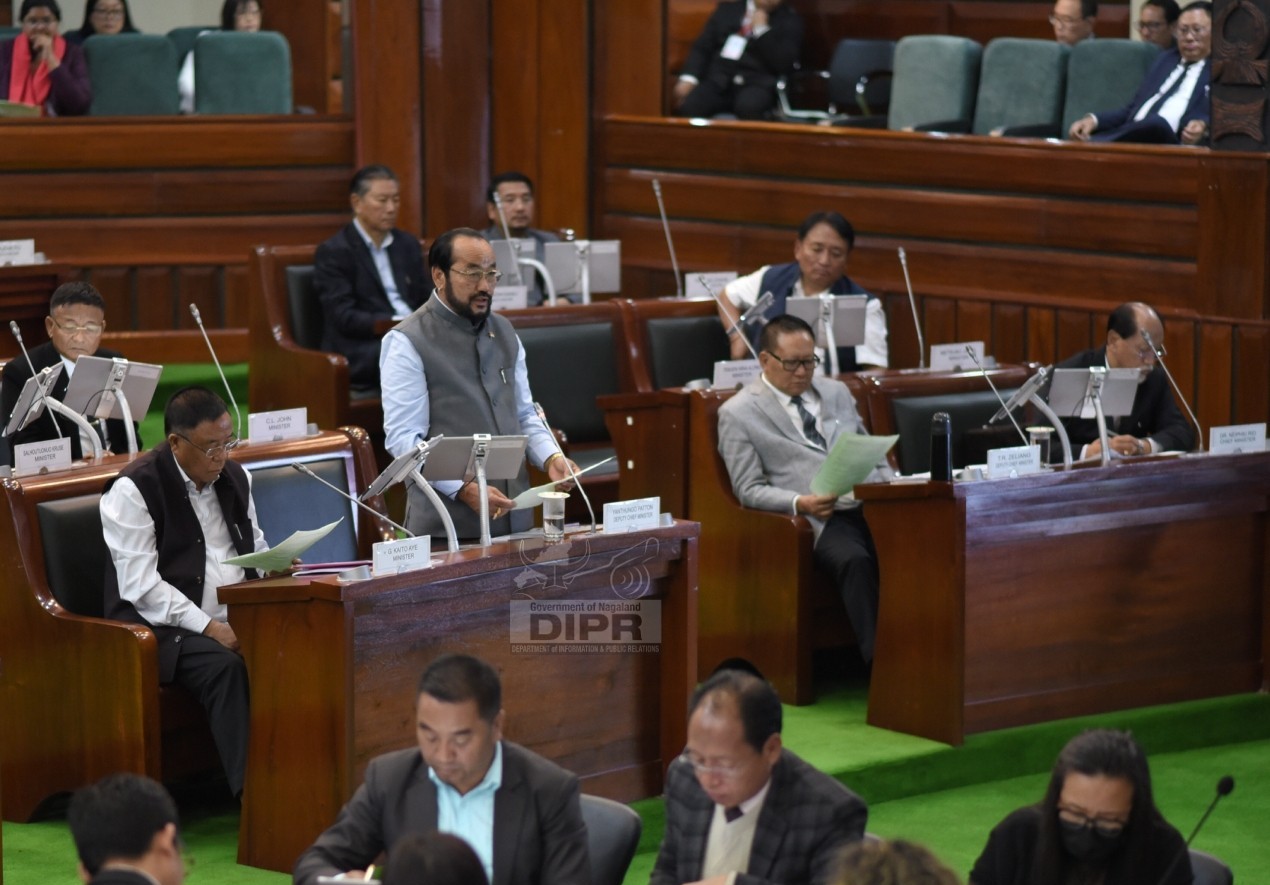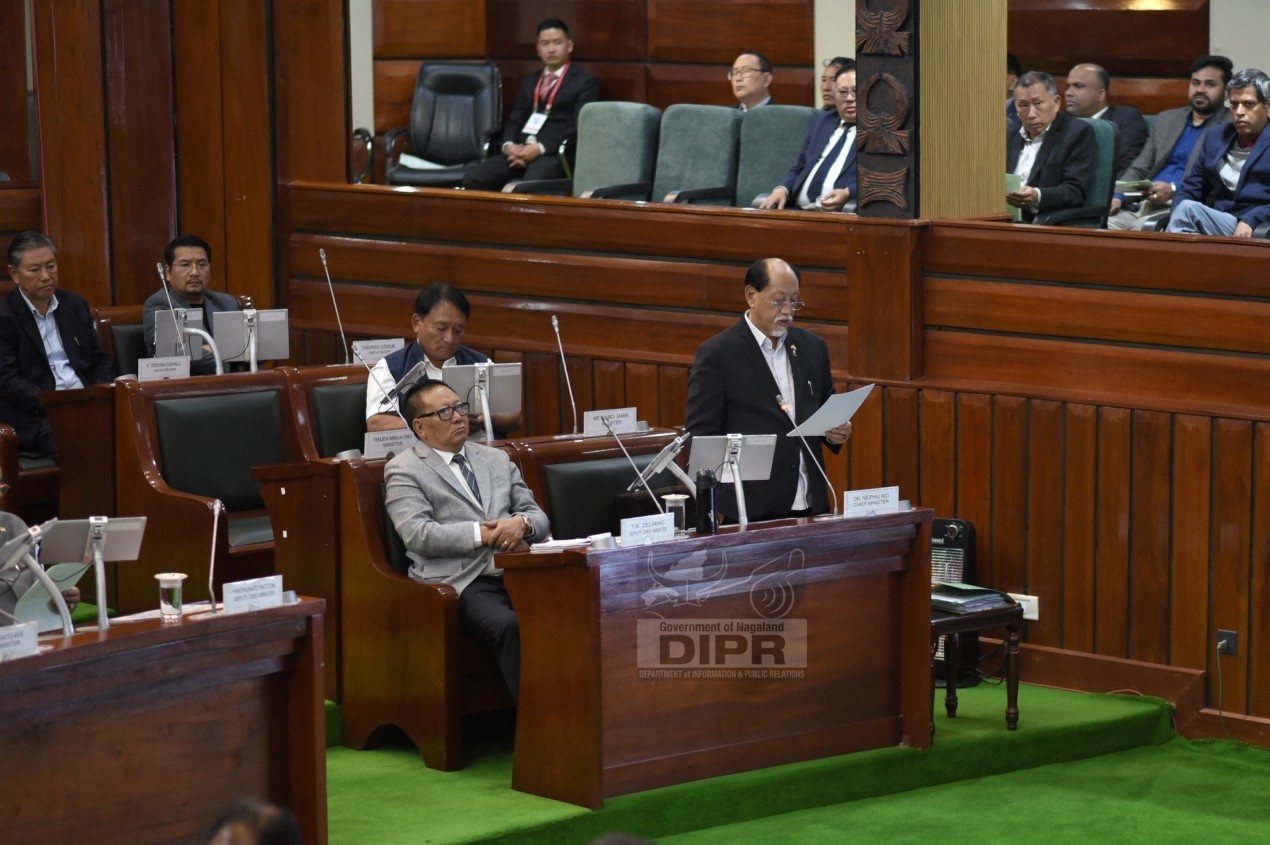

The Frontier Nagaland Territorial Authority (FNTA) Bill, 2026 introduced by Deputy Chief Minister, Yanthungo Paton on March 26, 2026 and scheduled for consideration and passage on March 27, 2026 was deferred to the next emergent session of the House. The decision followed a request by the Leader of the House and Chief Minister, Dr. Neiphiu Rio to refer the Bill back to the Government for further examination on March 27, 2026, at the NLA Hall, Kohima.
The deferral comes in response to a request from the Government of India, a signatory to the Memorandum of Agreement (MoA), along with appeals from the Eastern Nagaland Peoples’ Organisation (ENPO) and the Eastern Nagaland Legislators Union (ENLU) and keeping in mind the necessity of ensuring that the provisions of the MoA are addressed in a legally sound and constitutionally tenable manner in the FNTA Bill 2026.
On March 26, 2026, the Ministry of Home Affairs informed the State Government that the issue of granting legislative powers to the FNTA, previously raised by the State Government is still under examination. The Ministry further stated that the opinion of the Solicitor General of India is being sought. Accordingly, the State Government has been asked to allow additional time and to proceed with any further action on the Bill only after receiving the Ministry’s views.
Additionally, the ENPO submitted an appeal urging that the provisions of the MoA signed on February 5, 2026, be upheld while passing the FNTA Bill. The ENLU also wrote to the Minister for Parliamentary Affairs, referring to the ENPO’s appeal and requesting that the passage of the Bill be deferred until all concerns are addressed and clarity on the MoA is achieved.
Appraising the house on the Frontier Nagaland Territorial Authority Bill 2026 the Chief Minister Dr. Neiphiu Rio said that the government has consistently striven to ensure equity and inclusiveness in development across all sections and regions of the State. However, owing to various historical reasons and geographical challenges, the districts of the Eastern Nagaland Region have suffered significant developmental deficits and continue to lag behind on several key indicators despite continued initiatives and interventions of the government coupled with limited resources and have not been able to attain the same levels of progress as other parts of the State.
He stated that the State Government, fully appreciate and understand the aspirations of the people of Eastern Nagaland for an institutional arrangement in the form of the Frontier Nagaland Territorial Authority, and therefore has extended its support and worked jointly with the Government of India in holding consultations and building consensus, which culminated in the signing of the Memorandum of Agreement on 5th February, 2026, between the Government of India, the Government of Nagaland, and the ENPO for the establishment of the FNTA within the State of Nagaland.
Highlighting the objective of constituting the FNTA, Dr. Rio said that the arrangement is to establish a unique self-governing Territorial Authority that will enable the people of six Districts of Eastern Nagaland Region, namely Tuensang, Mon, Longleng, Kiphire, Noklak and Shamator to fulfill their social, economic, educational, cultural, and linguistic aspirations. It is also envisaged for a comprehensive economic development of the Eastern Nagaland Region aligning its progress with the rest of the State.
He further stated that the State Government will be allocating funds to FNTA based on its population and size, and also the Government of India will be sanctioning requisite Funds under various schemes or programme of the Ministry as Special Development Grants for development of infrastructure within FNTA and for which, the FNTA will themselves identify such development projects in consultation with the State Government.
Additionally, the FNTA will also prepare its own Annual Plan within the allocated funds for the departments and subjects under its control and will have its own planning/finance set-up to formulate development plans based on grassroots needs. The State Government on its part will ensure timely release of funds in accordance with laid-down norms of the State Government as well as the Central Government. As per Clause 3.3 of the Memorandum of Agreement, the FNTA is to be constituted under a special legislation to be enacted by the State Government in consultation with the Ministry of Home Affairs.
Following the signing of the Memorandum of Agreement MoA signed on 05.02.2026, the concerned State Departments, started preparing the Bill by incorporating the various provisions of the MoA for the creation of FNT/FNTA. During a Cabinet meeting on 26.02.2026 to deliberated on the draft Frontier Nagaland Territorial Authority Bill prepared by the Law and Justice Department, the Cabinet noted that the provisions of the MoA, inter alia, envisaged to give legislative powers to FNTA.
However while seeking the views of the Advocate General in this regard, he opined that under the constitutional scheme, legislative powers cannot be conferred on the FNTA through a State legislation. Upon further deliberation, the Cabinet also observed that the State Government does not possess the legislative competence to delegate powers equivalent to its own or to transfer its legislative authority to another body/authority.
Accordingly, the Cabinet directed the Chief Secretary to communicate the Advocate General’s opinion and the Cabinet’s observations to the Ministry of Home Affairs, with a copy to the ENPO. The State Government formally wrote to the Ministry on March 6, 2026, regarding legislative powers under Clause 3.3 of the MoA.
On March 10, 2026, the Ministry asked the State Government to initiate steps for constituting the FNTA through State legislation in consultation with the Ministry and to submit a draft proposal. Discussions were also held with the Union Home Secretary on March 16, 2026 where the need for early establishment of the FNTA was emphasized.
Subsequently, the draft Bill prepared by the Law & Justice Department, after being vetted by the Advocate General, was forwarded to the Ministry on March 17, 2026 in terms of clause 3.3 of the MoA. Meanwhile, ENPO representatives met the Chief Minister on March 24, 2026, and urged that the Bill be passed before their Central Executive Council meeting scheduled for March 30, 2026.
Considering these developments, the Cabinet met again on March 25, 2026, and approved the draft Bill with necessary modifications for introduction in the ongoing Assembly session on March 26, 2026 which has been deferred to the next emergent session of the House.
(DIPR)