
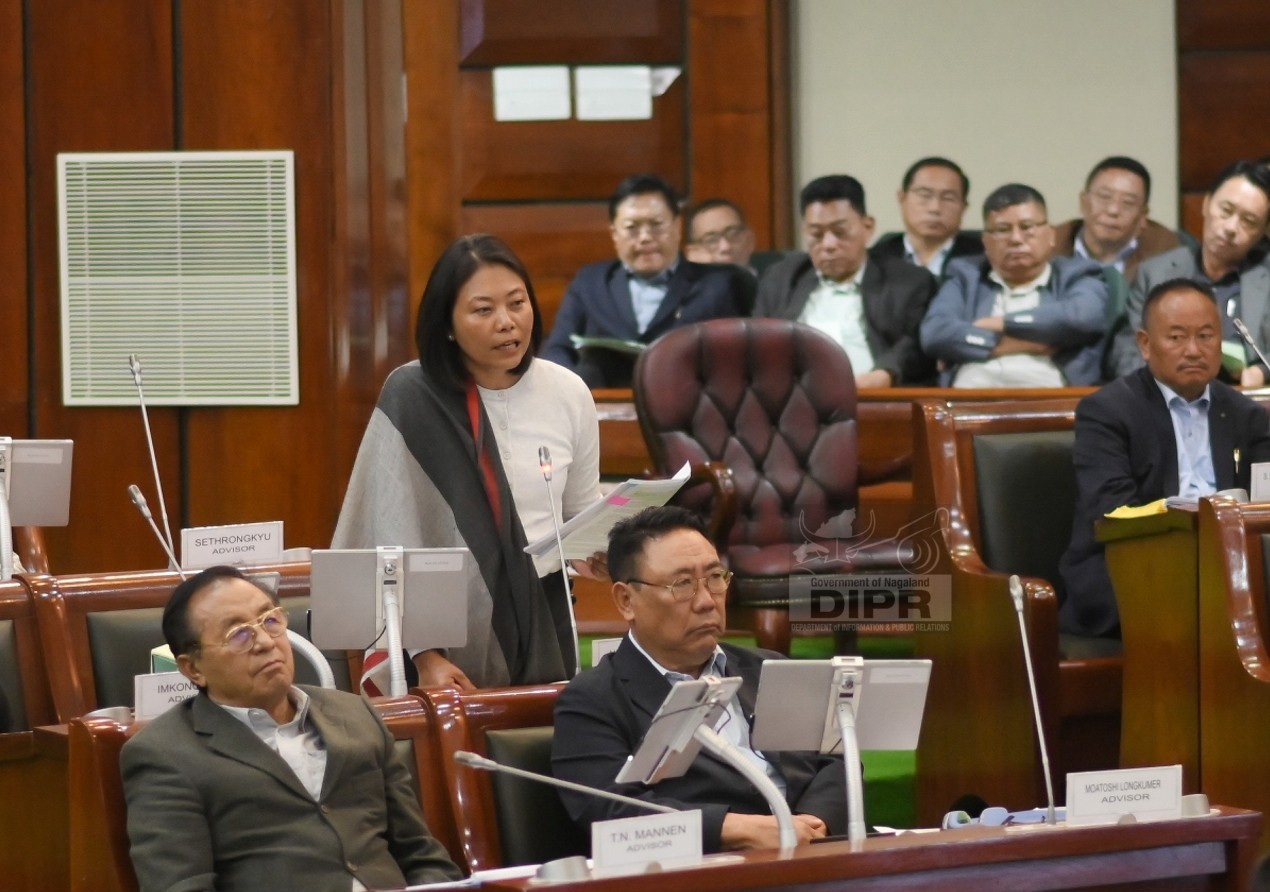
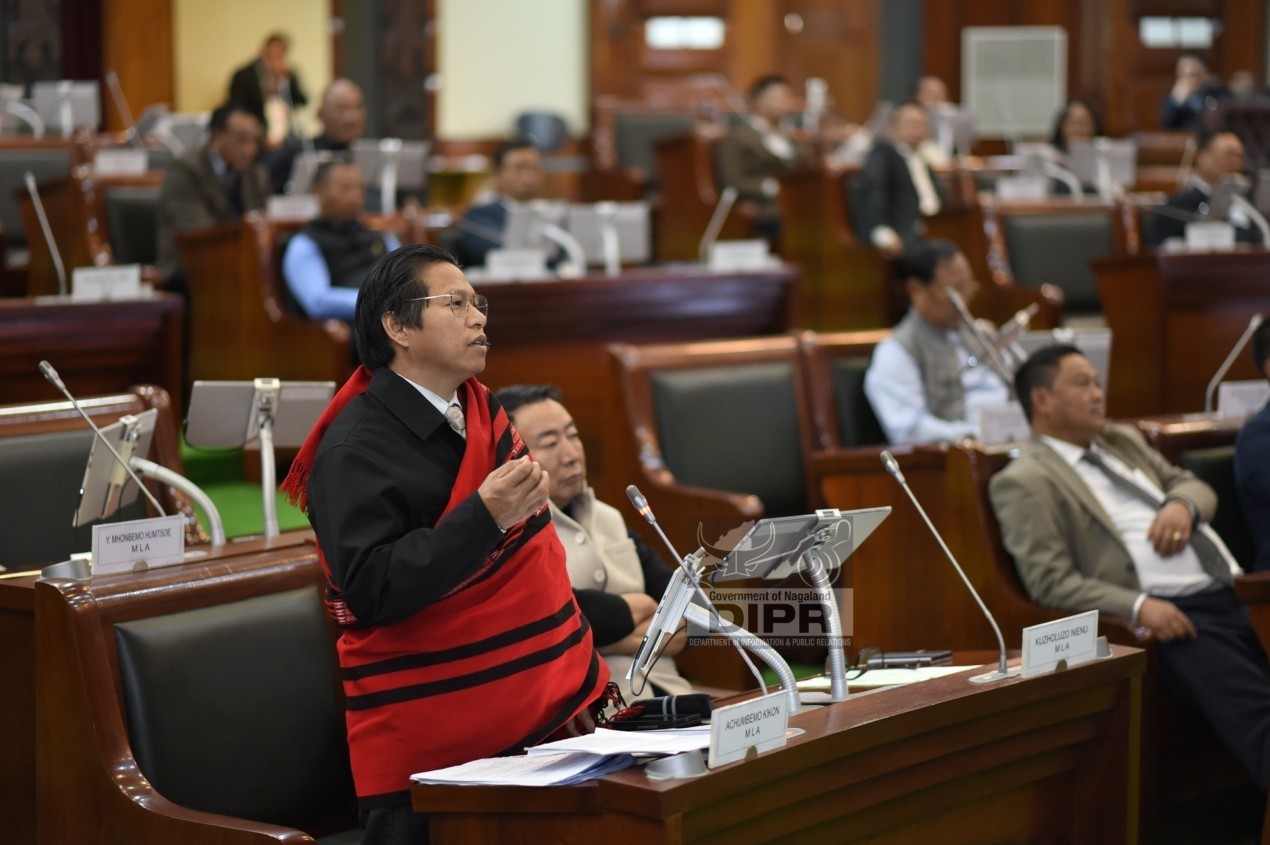
On the last day of the Phase-II of the Eighth session of the 14th Nagaland Legislative Assembly, several legislators expressed appreciation for the State Budget 2026–27, at NLA Hall, Kohima on 27th March 2026.
Advisor for Industries & Commerce, Hekani Jakhalu while initiating the discussion, described the State Budget 2026–27 as visionary and futuristic.
Highlighting the broader vision of the Budget, Jakhalu stated that despite financial challenges, the government remains committed to building a “Viksit Nagaland.” She noted that the Budget aligns with the Sustainable Development Goals and provides a clear roadmap for inclusive growth, improved governance, and sustainable development.
Praising its women-centric approach, Jakhalu credited the Chief Minister for demonstrating a strong commitment to women-led development. She underscored and lauded several key initiatives outlined in the Budget, including an innovation seed fund for nano women entrepreneurs, women’s participation in the workforce, such as the establishment of crèches in major government establishments to ensure better workforce stability. Emphasising equal opportunities, Jakhalu pointed to emerging prospects and praised initiatives supporting women in sectors such as transportation, asserting that women are equally capable and that the government is actively promoting their economic inclusion. She further noted that provisions to promote women-led startups have been included in the Budget, while urging beneficiaries to utilise the funds judiciously.
On economic priorities, Hekani stressed the vital role of Micro, Small and Medium Enterprises (MSMEs) in driving employment and growth. She said the Budget places due emphasis on strengthening MSMEs, improving market linkages, and promoting local products to boost the State’s economy. She also raised concerns over the protection of traditional designs and motifs, calling for safeguards against exploitation and advocating for Geographical Indication (GI) tagging to support indigenous industries.
Describing the Budget as more than a financial statement, she said it reflects a forward-looking and practical vision, with a strong focus on entrepreneurship, startups, and investor-friendly policies aimed at improving the ease of doing business and attracting investments.
She also acknowledged steps taken in agriculture and allied sectors, including modern farming, horticulture, and value chain development to enhance farmers’ income and ensure food security.
Advisor for School Education and SCERT, Dr. Kekhrielhoulie Yhome, expressed appreciation for the State Budget 2026–27 during the general discussion, applauded the Chief Minister for what he described as a progressive financial roadmap.
Yhome observed that, in comparison to previous budgets, the current proposal reflects notable improvement, particularly for a resource-constrained state like Nagaland with limited revenue avenues. He said the budget demonstrates a more forward-looking approach, aimed at addressing developmental gaps while strengthening key sectors. Highlighting the introduction of new initiatives, the Advisor noted that these measures are expected to enhance and upscale social innovation across the state. He added that such interventions could play a crucial role in modernising systems and improving overall governance outcomes.
Yhome further expressed optimism that the projects and policy directions outlined in the budget would enable Nagaland to keep pace with developments in other regions, including at the international level. He emphasised that the focus on innovation and capacity-building could significantly contribute to long-term growth. He pointed out that special attention has been given to empowering women entrepreneurs and the youth, which he said would help create sustainable opportunities and drive economic progress in the state.
Advisor, Water Resources, Tongpang Ozukum applauded the Budget 2026-2027 terming it as a robust and enhanced budget which clearly demonstrated his strong financial acumen and concern for the people of Nagaland.
He congratulated the Eastern Nagaland Peoples’ Organisation (ENPO) for signing a historic Memorandum of Understanding (MoU) with the Government of India and the Government of Nagaland on 5th February 2026 on the formation of Frontier Nagaland Territorial Authority (FNTA). In which, the inclusion of eastern dialects to be taught in all educational institutions in the eastern areas is laudable, he said. Hence, he requested the State government to look into the problems of these people pertaining to recruitment and the examination centers particularly for Phom and Chang communities residing in Mokokchung district.
On construction of Trans-Nagaland Highway (Foothill Road), he lauded the Government of the day by engaging all the tribal Hohos and stakeholders to sort out differences and make them understand the difficulties involved in this project. Also urged the elected members to make sure that people are aware of what the government has been doing as far as this project is concerned. He appealed to the august house that the State government should regularly approach the Central government for its successful completion. He also lauded the Taxes Department for their tremendous efforts in enhancing the GST collection.
MLA, Achumbemo Kikon, while participating in the general discussion on the Budget for the year 2026–2027, highlighted the Government’s seriousness regarding the Naga political issue. He stated that the Government has been sincere in its efforts, and allegations against it are unwarranted. He emphasized that the present leadership is committed to leaving behind a positive legacy for the people while safeguarding the Naga identity.
Referring to the recent delegation led by the Chief Minister that met the Union Home Minister on the Naga political issue, he described the meeting as fruitful. He stated that during the discussions, it was clearly conveyed that the Naga issue is a political issue and must be resolved at the highest level. He expressed hope that the Central Government would demonstrate greater seriousness in arriving at an honourable solution.
Speaking on the financial situation, he observed that Nagaland is nearly two decades behind the rest of the country in terms of recognition by the Finance Commission. He urged the Central Government to accord due importance to the State in the 16th Finance Commission. He also lauded the Chief Minister for prioritizing climate change, stressing that it is an issue that deserves serious attention.
Further, he expressed gratitude for the enhancement of the Local Area Development Programme fund for MLAs and suggested that it be renamed as “Vamuzo Local Area Development Programme” in honour of the former Chief Minister Vamuzo Phesao. Additionally, he urged the Government to reconsider increasing budgetary allocations for border areas.
MLA, Dr. Neisatuo Mero, while participating in the general discussion on the Budget for the year 2026–2027, stated that it supports the financial roadmap of the State. He said that despite financial difficulties, the Budget is well-balanced and deserves appreciation for bringing down the State’s financial deficit.
He further described the Budget as innovative, as it focuses on both the present and the future. It clearly reflects that the Government is investing in the welfare and aspirations of the people. The Budget emphasizes gender equality and is women-centric, representing a paradigm shift towards women-led development.
Highlighting that agriculture is the backbone of the State, he said the Budget reassures farmers and reflects a strong commitment to food security, as farmers play a crucial role in boosting the State’s economy. He also pointed out that since the State has a high meat consumption rate, there is a need to upgrade veterinary facilities to ensure the availability of high-quality products.
On the allocation for youth, he stated that young people are the future of the State and emphasized the importance of investing in them. Speaking on the power sector, he noted that Government investment sends a strong message about ensuring power connectivity to every household.
Referring to the health sector, he said that increased investment demonstrates the Government’s commitment to the well-being of the people.
He further appealed to the concerned authorities to complete Package II of the Kohima–Pfutsero Road before the monsoon.
Advisor for Fisheries & Aquatic Resources, A. Pangjung Jamir, participated in the Budget discussion during the ongoing Session of the Nagaland Legislative Assembly and extended his support to the Budget proposals for the financial year 2026–27 presented by the Chief Minister.
Jamir described the Budget as a forward-looking and practical document that provides a clear roadmap for the State’s growth and development in line with the vision of Viksit Bharat 2047. He said the Budget reflects transparency and a strong commitment to inclusive development.
He appreciated key initiatives focused on women empowerment, skill development, and livelihood generation, which aim to strengthen the workforce and promote self-reliance. He also welcomed investments in water supply, renewable energy, and other infrastructure sectors.
Highlighting youth development, Jamir noted the importance of skill training and employment initiatives to improve job opportunities. He also acknowledged the focus on education in emerging sectors such as digital economy and technology. Emphasising agriculture and allied sectors, he said that investments in farming, horticulture, livestock, and fisheries would support rural livelihoods and boost the State’s economy. On fisheries, Jamir stressed the need to increase production and better utilise available resources to reduce dependence on imports and move towards self-sufficiency. He also highlighted the importance of infrastructure development, including roads, administrative buildings, and urban amenities for overall progress.
Advisor for Food & Civil Supplies and Legal Metrology, K. T. Sukhalu also participated in the discussion and commended the Chief Minister for presenting a comprehensive and strategic Budget despite fiscal challenges arising from the discontinuation of post-devolution revenue deficit grants.
Sukhalu expressed confidence in the leadership of the Chief Minister, stating that his engagement with the Union Finance Minister would yield positive outcomes for the State.
Referring to concerns raised by successive Finance Commissions on the high revenue expenditure of the State, particularly on salaries, he pointed out that such issues may have arisen due to past irregular appointments made without sanctioned posts. He stressed that strict action must be taken against any officers or officials found violating established procedures.
The Advisor noted that as a welfare State, Nagaland cannot sustain essential services if citizens do not pay service charges such as electricity and water bills. He suggested that the concerned departments conduct awareness campaigns with the support of civil society organisations, village authorities, student bodies, and churches to encourage responsible payment practices.
On revenue generation, Sukhalu highlighted the potential for oil exploration in the State and called for immediate steps to initiate the process. He also suggested reviewing the Nagaland Liquor Total Prohibition (NLTP) Act, 1989, in view of its limited effectiveness.
Expressing concern over the rising incidence of drug abuse, Sukhalu cited reports indicating increased production of illicit opium in neighbouring Myanmar, which makes Nagaland vulnerable to drug trafficking. While appreciating the efforts of law enforcement agencies, he emphasised that stronger policy-level decisions are required to effectively address the issue.
He stated that the current prohibition regime has not been successful in curbing liquor consumption, as alcohol continues to be easily available, often in adulterated and unsafe forms. He noted that this has led to serious social and health consequences for many families.
The Advisor further highlighted the need for a balanced and pragmatic approach, stating that the issue of prohibition requires open and informed discussion. He stressed that any policy decision should consider both public welfare and regulatory mechanisms rather than focusing solely on revenue aspects.
Sukhalu underscored the importance of reducing the State’s dependence on borrowing and improving fiscal sustainability through enhanced revenue generation and effective policy reforms. He called for responsible governance and proactive measures to ensure long-term economic stability and public welfare.
(Nongozo Rikha, Asst. Director, Kazuhito IA, Avika IA, Mainodi IA)


