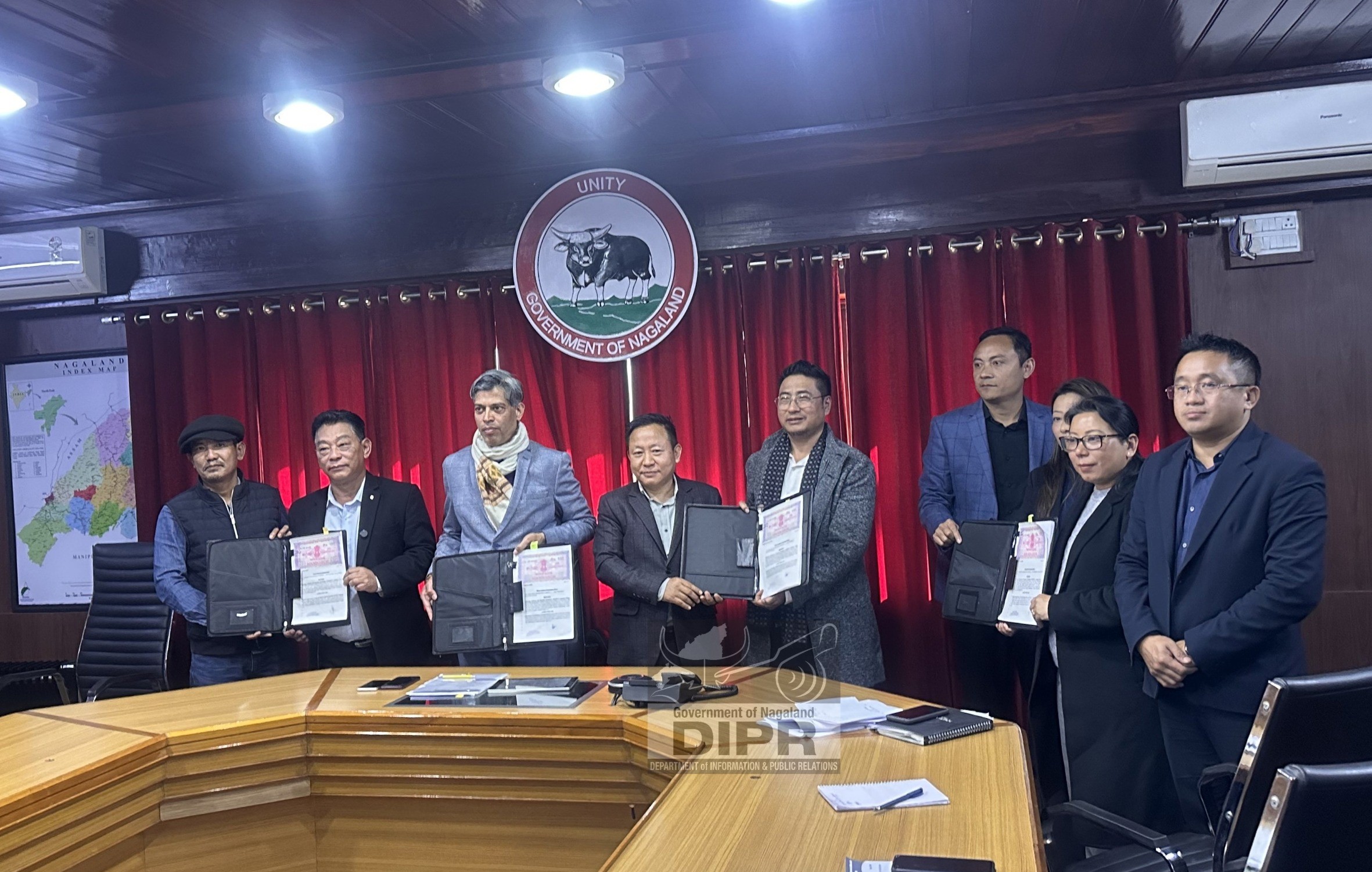
The Government of Nagaland signed Memorandum of Agreements (MoAs) with the Department of Land Resources (DoLR) and the Nagaland Environmental Protection and Economic Development Society (NEPED) under the ELEMENT Project, at the Chief Secretary’s Conference Hall, Nagaland Civil Secretariat, Kohima on 18th December 2025.
Delivering the keynote address, V. Shashank Shekhar, IAS, Additional Chief Secretary & APC and Mission Director, ELEMENT, said that collaboration with various State and Central departments and agencies forms a core part of the project’s implementation strategy. He informed that discussions with multiple departments had been underway and that the signing of these MoAs marked the beginning of strength and expanded partnerships in the coming days.
He highlighted that the ELEMENT Project is jointly supported by the State Government, Government of India, and the World Bank. While the World Bank has extended a loan for the project, the responsibility of repayment rests jointly with the State Government and the Government of India. The overarching objective of the project, he said, is to improve the quality of life of the common people.
Speaking on the MoA with the Department of Land Resources, Shashank Shekhar emphasized the importance of springshed development, noting that water is fundamental to life and civilization. Drawing parallels with ancient river valley civilizations, he cautioned that unchecked extraction of water through borewells and tankers without adequate replenishment could lead to severe water scarcity in the future. The collaboration with DoLR, he said, aims to strengthen ongoing efforts toward water resource rejuvenation and sustainability.
On the partnership with NEPED, he underscored the critical role of research and development (R&D) in economic prosperity. NEPED, he noted, has a proven track record of successful R&D initiatives. Through new and enhanced R&D projects, the ELEMENT Project seeks to improve livelihoods, generate employment, and strengthen the local economy by promoting products manufactured within Nagaland.
He commended the concerned departments and the NEPED team for their dedicated efforts over the past months in finalizing and fine-tuning the agreements. He also acknowledged the role of the media in disseminating project-related developments to a wider audience. Extending festive greetings, he expressed hope that the coming year would usher in new beginnings and strengthened partnerships, all aimed at benefiting the common people.
Short speeches were delivered by Hukato N, Additional Director, Land Resources Department, and Kovi Meyase, NCS, Team Leader, NEPED, who reaffirmed their commitment to effective implementation of the project objectives.
The vote of thanks was delivered by Limanenla, Joint Secretary, Agriculture Department.
ELEMENT Project Signs MoA with Department of Land Resources to Strengthen Springs and Coffee Development in Nagaland.
The Government of Nagaland, with financial support from the World Bank–IBRD, has signed a Memorandum of Agreement (MoA) with the Department of Land Resources (DoLR) under the ELEMENT Project implemented through the Society for Climate Resilient Agriculture in Nagaland (SoCRAN).
The ELEMENT Project aims to restore degraded landscapes, build climate resilience, and improve livelihoods across 225 villages in 16 districts of the State over a five-year period ending in 2030.
Under the MoA, DoLR has been designated as the State Technical Partner for Springshed Development and Coffee Development. The initial engagement is for one year with provision for annual renewal based on performance, which will be reviewed biannually by the State Project Management Unit (SPMU).
As part of this partnership, DoLR will provide comprehensive technical support, including resource mapping, spatial analysis, preparation of Detailed Technical Reports (DTRs), implementation planning, monitoring, and capacity building. Key interventions will focus on spring rejuvenation, sustainable coffee plantation planning, and installation of Customized Automatic Weather Stations (CAWS). Hydrological and climate data generated under the project will be integrated into the ELEMENT Decision Support System (DSS) and ERP platforms to support informed planning and decision-making.
At the village level, project activities will be implemented through Village Management Committees (VMCs) with support from Project Facilitating Agencies (PFAs) and Zonal Management Units (ZMUs), under the technical guidance of DoLR. Community members and village animators will be trained to ensure local ownership, sustainability, and long-term impact.
The ELEMENT Project–SPMU will oversee coordination, approvals, procurement, monitoring, and compliance with World Bank fiduciary and environmental and social safeguard requirements. All data and outputs generated under this collaboration will remain the property of the Government of Nagaland and the ELEMENT Project.
This partnership marks a significant step towards sustainable water security, climate-resilient agriculture, and livelihood enhancement in Nagaland’s hill ecosystems.
Nagaland Strengthens Climate-Resilient Livelihoods through Indigenous Technologies under ELEMENT Project.
The Government of Nagaland, with support from the World Bank–IBRD, has initiated a major step to strengthen climate-resilient livelihoods and sustainable development across 225 villages in 16 districts under the ELEMENT Project, implemented through the Society for Climate Resilient Agriculture in Nagaland (SoCRAN).
As part of this initiative, the Nagaland Empowerment of People through Economic Development (NEPED), through its Centre of Excellence for Renewable Energy Studies (CERES), has been engaged as a State Technical Partner for research, innovation, and technology development. The partnership will run for 18 months with scope for extension based on performance.
The collaboration focuses on designing, fabricating, and deploying low-energy, indigenous technologies tailored to Nagaland’s hill ecosystems. These include zero-energy cold storage systems, hybrid dryers, micro-hydro units, sustainable waste-management solutions, and low-energy agricultural machinery aimed at reducing post-harvest losses, improving rural incomes, and enhancing climate resilience.
A key component of the initiative is the revival and strengthening of CERES as a state-owned hub for research and development, fabrication, skills training, and enterprise incubation. Local youth, Self-Help Groups (SHGs), and village institutions will be trained to adopt and manage these technologies, ensuring community ownership and long-term sustainability.
The technologies will be piloted, scientifically validated, and scaled up through community institutions and local entrepreneurs, contributing to livelihood diversification, value-chain strengthening, and environmentally sustainable practices. All activities will follow World Bank environmental and social safeguards.
Through this initiative, the ELEMENT Project aims to build community confidence, promote innovation rooted in local knowledge, and position Nagaland as a leader in climate-smart, people-centred development
The total Project Cost stands at ₹ 574.63 crore covering 225 village under 16 district. The Project duration will be for 5 years.
(Kazuhito, IA)