

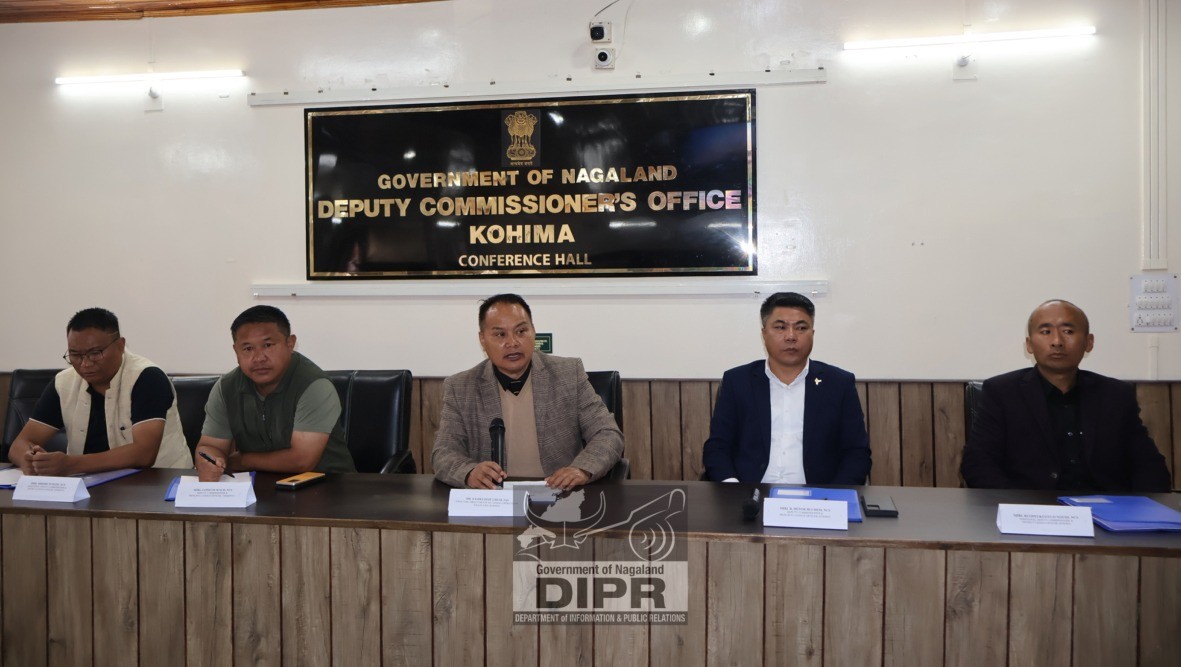
A two-day district-level training programme for the first phase of the Census of India 2027 commenced on April 22 at the Conference Hall of the Deputy Commissioner, Kohima. The training, organised by the Directorate of Census Operations, Nagaland, will continue till April 23, 2026.
Administrative Officers from Kohima and Tseminyu districts are participating in the training, which aims to equip census functionaries with the necessary skills and knowledge for the upcoming nationwide census exercise.
Director of Census Operations, Nagaland, Dr. Zasikuolie Chusi, IAS, expressed appreciation to the Deputy Commissioners for facilitating the district-level training. He stated that the census, conducted every ten years since 1881, remains a vital national exercise. He informed that the upcoming Census 2027 will be conducted in a fully digital and paperless mode, with all processes to be carried out through dedicated applications. The first phase, comprising the House Listing Operation, is scheduled to begin from July 1, 2026.
Highlighting key concerns, he pointed out that demographic changes observed in the 2011 Census, including variations in population growth and rural-urban distribution, require careful attention. He emphasised that accurate enumeration, especially of vacant households, is critical and urged charge officers to carry out their duties meticulously.
Deputy Commissioner & Principal Census Officer, Kohima, B. Henok Buchem in his address, recalled his experience of participating in the 2011 Census and encouraged the officers to treat the assignment as a meaningful opportunity. He noted that while the work may be demanding, it would be a satisfying experience in the long run. He emphasised that field realities often present challenges beyond classroom training, and urged the participants to remain attentive, adaptable and committed to delivering their responsibilities effectively.
Deputy Commissioner & Principal Census Officer, Tseminyu, Japheth Woch sharing his experience, described census operations as rigorous and time-consuming, often involving extended working hours and extensive field engagement. He stated that although the system of operations has evolved over the years, the training would adequately prepare officers for the task ahead. He highlighted that census work involves multiple challenges at the ground level and stressed the importance of developing a problem-solving mindset to address field-level issues.
The training programme covered topics such as an introduction to Census 2027, roles and responsibilities of census functionaries, legal provisions, fund management and publicity activities. Sessions were also conducted on the Census Management and Monitoring System (CMMS), including its modules, features, user registration, and management of House Listing Operations and House Listing Blocks. Participants were further trained on generation of appointment letters and identity cards, layout map preparation, self-enumeration processes, and preparation of village, town and charge registers.
(Molungnenla, IA Kohima)


