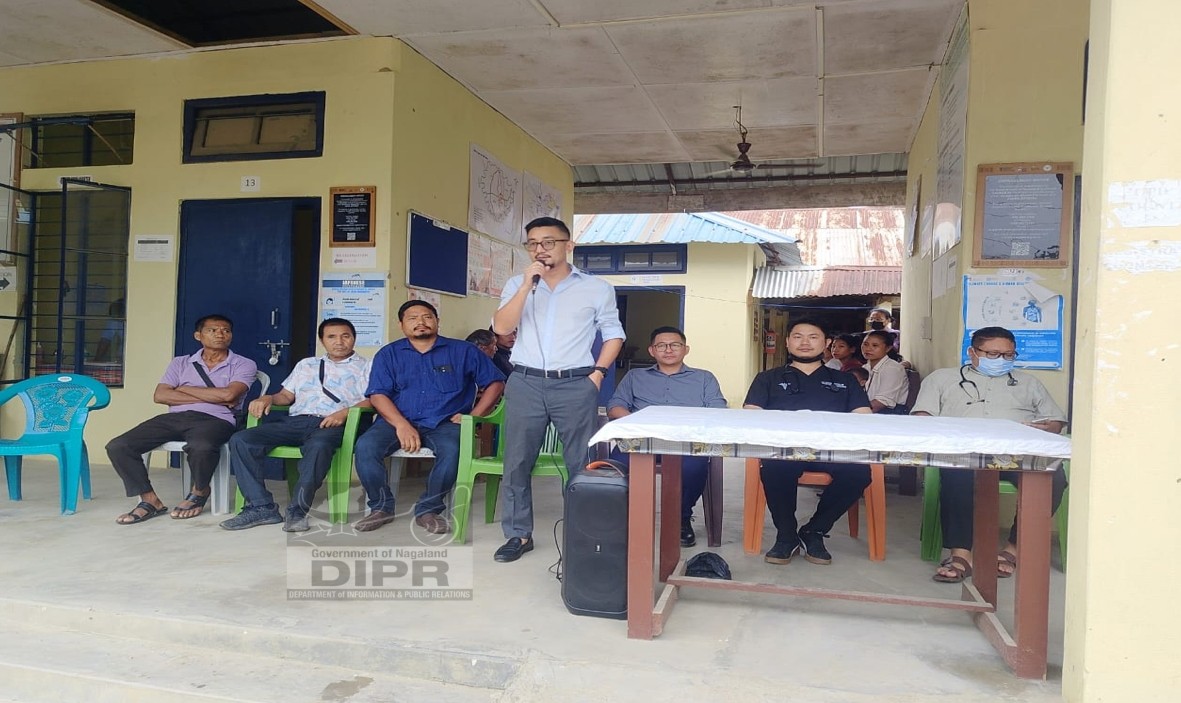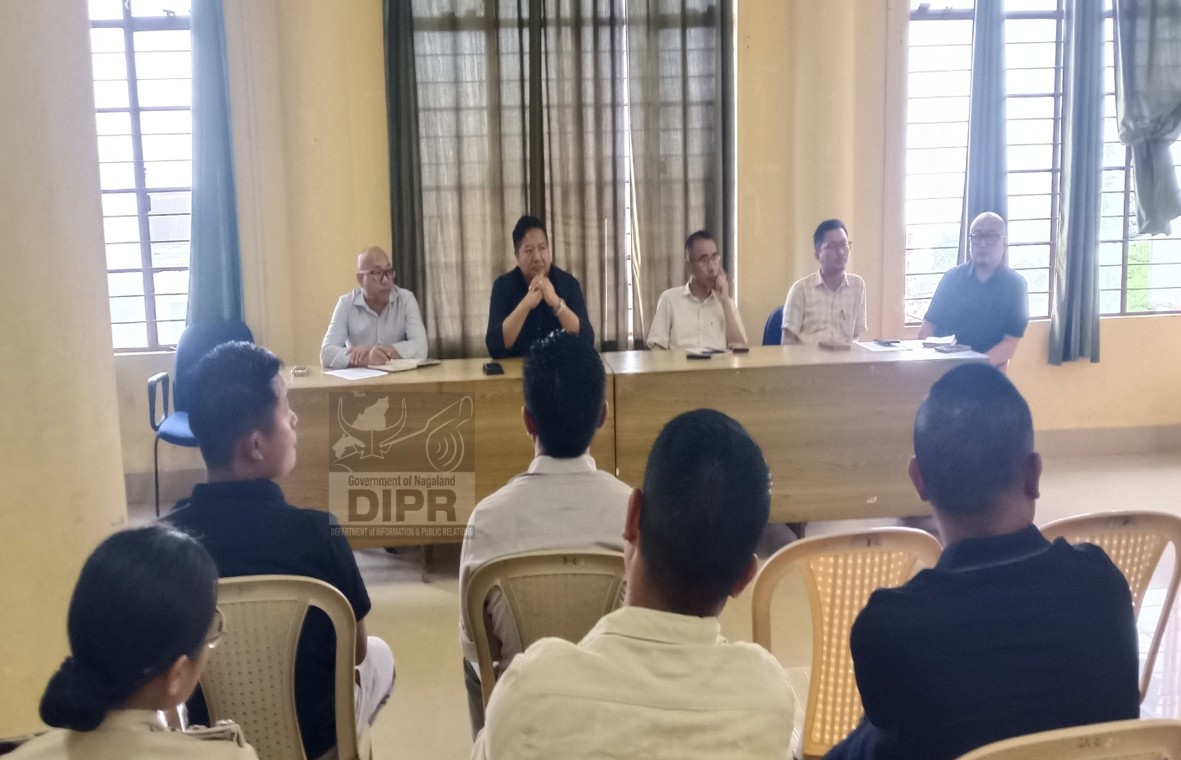
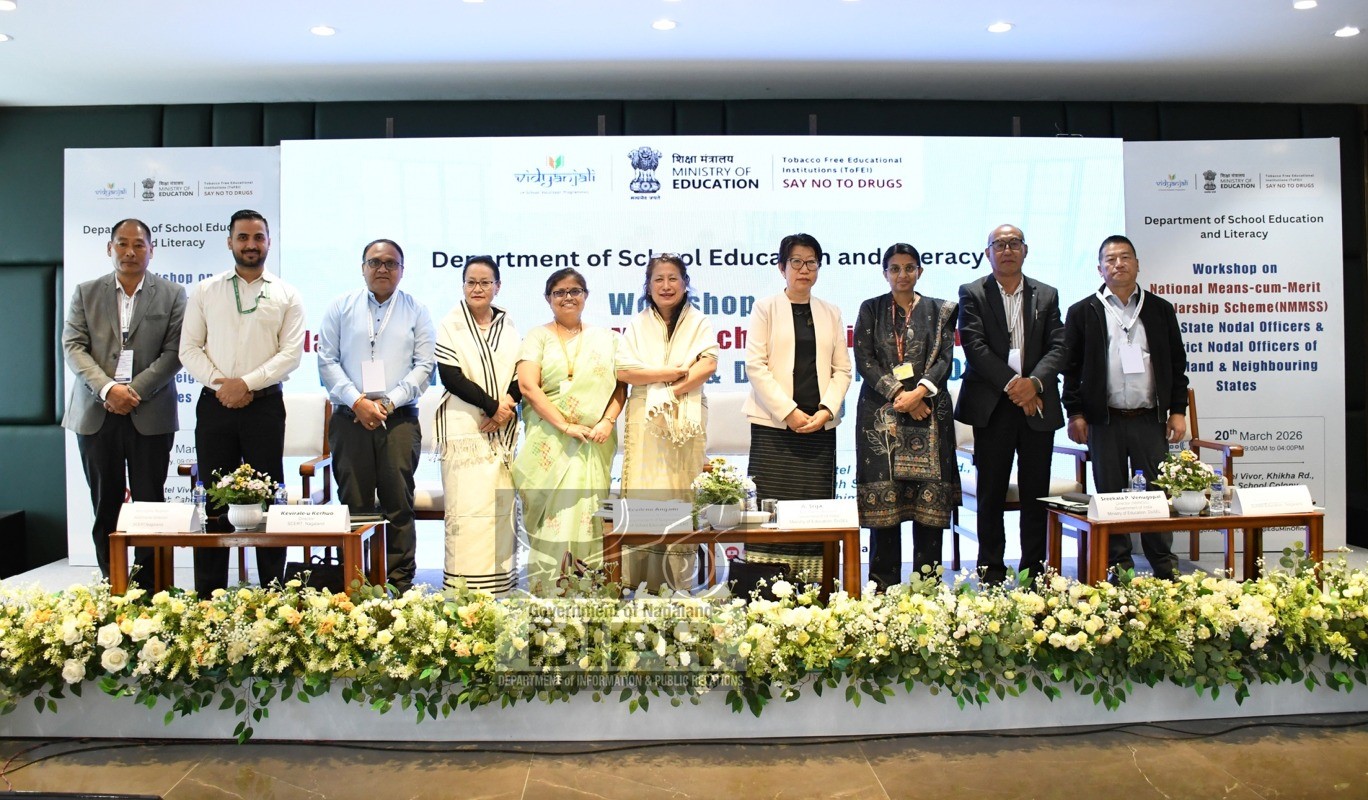
A one-day interactive Workshop on National Means-cum-Merit Scholarship Scheme (NMMSS) with State Nodal Officers & District Nodal Officers of Nagaland and Neigbouring States organised by the Ministry of Education, Department of School Education and Literacy was conducted at Hotel Vivor, Kohima on 20th March 2024.
Speaking on the occasion, Commissioner & Secretary of School Education Kevileno Angami emphasized that the NMMSS aims to address educational challenges in North East states through collaboration and shared learning. She highlighted that initiatives like the Right to Education, National Education Policy, Samagra Shiksha, and Sarva Shiksha Abhiyan ensure free and compulsory education up to age 14, while also strengthening foundational learning and reducing dropout rates in many regions.
However, she noted that some states still face high dropout rates due to financial constraints, lack of facilities, and environmental factors. She stressed that scholarships like NMMSS can help address these issues.
She urged officers to actively guide and support students—spreading awareness, helping them apply, and preparing them for exams—so that deserving children benefit. She also encouraged officers to use the workshop as an opportunity to learn from one another.
Director, SCERT, Kevirale-u Kerhuo in her address on the selection process for NMMSS said Nagaland has been allotted a quota of 180 scholarship, distributed equitably across all 17 districts, with exam centres generally located at district headquarters to ensure accessibility for candidates. She further noted that information about applications is shared through local newspapers, All India Radio, and the official SCERT website. The examination consists of two parts—the Mental Ability Test (MAT) and the Scholastic Aptitude Test (SAT). To qualify, students must score at least 40% marks, with a relaxation to 32% for SC/ST candidates.
Director, School Education, Raszouseyie Veyie speaking on scholarship schemes that are being implemented in the State, highlighted that five major scholarship schemes and three centrally sponsored schemes are currently being implemented by the Directorate of School Education.
A. Srija, Economic Advisor, DoSE&L, Ministry of Education, in her welcome address said that the workshop was organised to discuss the National Education Policy and the Merit Scholarship Scheme. She explained that the scholarship began in 2008 under the Right to Education to support students aged 6–14. It was introduced especially to help students who dropped out after Class 8 due to financial difficulties.
She noted that Over time, the scheme has improved through a selection exam and the use of technology. She added that linking it to the National Scholarship Portal has helped prevent fake entries and ensure genuine beneficiaries through proper verification. She further said that workshops are conducted across states to train district nodal officers so they can guide students in applying for the scholarship.
A. Srija noted that in Nagaland, although 180 scholarship slots are allocated across 17 districts, fewer students are registering on the National Scholarship Portal. She urged officials to make greater efforts to bring economically disadvantaged children back into the education system by helping them apply for the Merit Scholarship.
She also encouraged officers to continuously support students over the next four years by preparing them for the Mental Ability Test (MAT) and Scholastic Aptitude Test (SAT), and by raising awareness so that the state can fully utilize all 180 scholarships each year.
The inaugural session was followed by Presentation of NMMSS and implementation through NSP Portal, Q & A Session on NMMSS and NIC-NSP, Sensitization videos on NMMSS, power point presentation by NPCI and feedback Mechanism interaction with DEOs/DNOs.
(Maongtemjen, IA)