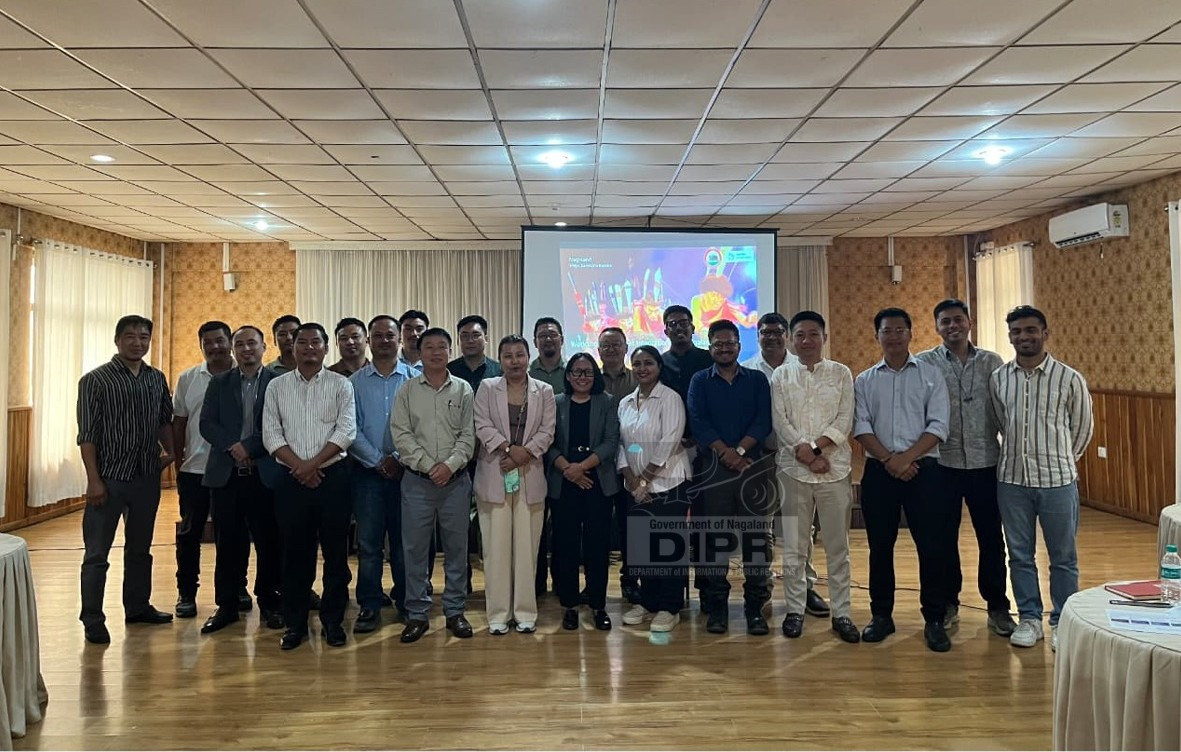


The Inter Media Publicity Coordination Committee (IMPCC) held its fifth meeting at the Directorate of Information and Public Relations (DIPR), Kohima, on 8th October, 2026 under the chairmanship of Ella Kayina, Head of Programme, Akashvani Kohima.
The meeting began with a condolence for the demise of Dr. Engam Pame IIS, Additional Director General, PIB & CBC and IMPCC Chairman who passed away on 1st October, 2026 at the age of 58.
Pusebozo Sophie, Head of Office PIB & CBC, Kohima in his address recalled Dr. Pame’s long and distinguished service, stating that he had contributed more than three decades to government communication, media coordination and public outreach after joining the Indian Information Service in 1994.
Dr. Pame was described as one of the longest-serving Group A officers from the region and as having played a significant role in strengthening coordination between government agencies and media organisations across the Northeast. The members observed a moment of silence in his honour.
Representatives of member organisations, including Akashvani Kohima, Doordarshan Kendra Kohima, Central Bureau of Communication, Press Information Bureau (PIB) and DIPR, presented reports on publicity and outreach activities undertaken during the previous month.
Mhareni Kithan, Junior Executive, Directorate of Census Operations, Nagaland and Alphonce Toppo, State Director, My Bharat, briefed the committee on initiatives undertaken by their respective offices and sought greater coordination from member media organisations for their upcoming programmes and activities.
Dzüvinuo Theünuo, Director, Directorate of Information and Public Relations, stressed the need for closer coordination among government communication agencies and media organisations amid the growing challenge of misinformation and fake news and ensuring the timely dissemination of accurate information. She also invited member organisations to share programmes, news items and other relevant information through its officers or official email for dissemination through DIPR platforms and assured that the department would extend necessary support through its communication channels.
The committee decided to hold its next meeting at the Directorate of Census Operations, Kohima.
(Ikedalule, APRO)
TRAINING HELD AHEAD OF PIMS v2 TRANSITION TO STRENGTHEN DIGITAL PERSONNEL MANAGEMENT
The Personnel and Administrative Reforms Department in collaboration with the Department of Information Technology & Communication, conducted a two-day training programme for PIMS Nodal Officers from various departments on the new version of the Personnel Information Management System (PIMS v2) at the Directorate of Information Technology & Communication, Kohima, on 7th and 8th October, 2026.
The training was organised as part of the Government’s preparations for the transition from the existing PIMS to PIMS 2.0, with the new Application scheduled to go live on 16th October, 2026. The initiative is aimed at further strengthening e-Governance by making employee-related services more accessible, efficient and convenient through an improved online system.
A total of 93 establishments and offices attended the two-day training. The participating PIMS Nodal Officers were familiarised with the new application through detailed walkthrough sessions, covering the various features and processes of PIMS 2.0 and the responsibilities of Nodal Officers in managing employee-related information and services.
The transition to PIMS 2.0 forms part of the Government’s efforts to move towards a more streamlined and accessible digital system for personnel and service management. The application will have dashboards to enable multi-level monitoring of processes.
The two-day training was therefore intended to ensure that departments are familiar with the new application and prepared for its implementation, enabling a smooth transition and uninterrupted delivery of employee-related services. The introduction of PIMS 2.0 is expected to further enhance accessibility and efficiency in personnel management through greater reliance on online processes and digital governance.
The session highlighted key changes in PIMS 2.0, particularly the introduction of individual login access for employees, in addition to PIMS Nodal Officers. This will enable employees to view and check their own records directly, reducing the workload on Nodal Officers. The new system will use DigiLocker-based authentication, requiring users to link their PIMS details with their DigiLocker accounts. Participants were encouraged to register and familiarise themselves with the process during the training.
It was also impressed upon all departments to extend full cooperation and play their respective parts in strengthening governance in the state.
(Mainodi Naben, IA)