
Photo News · Kohima
The Department of Environment, Forests and Climate Change, Government of Nagaland, is exploring the potential for commercial cultivation of Sandalwood and Red Sanders in the State in collaboration with scientists from the Indian Council of Forestry Research and Education (ICFRE).
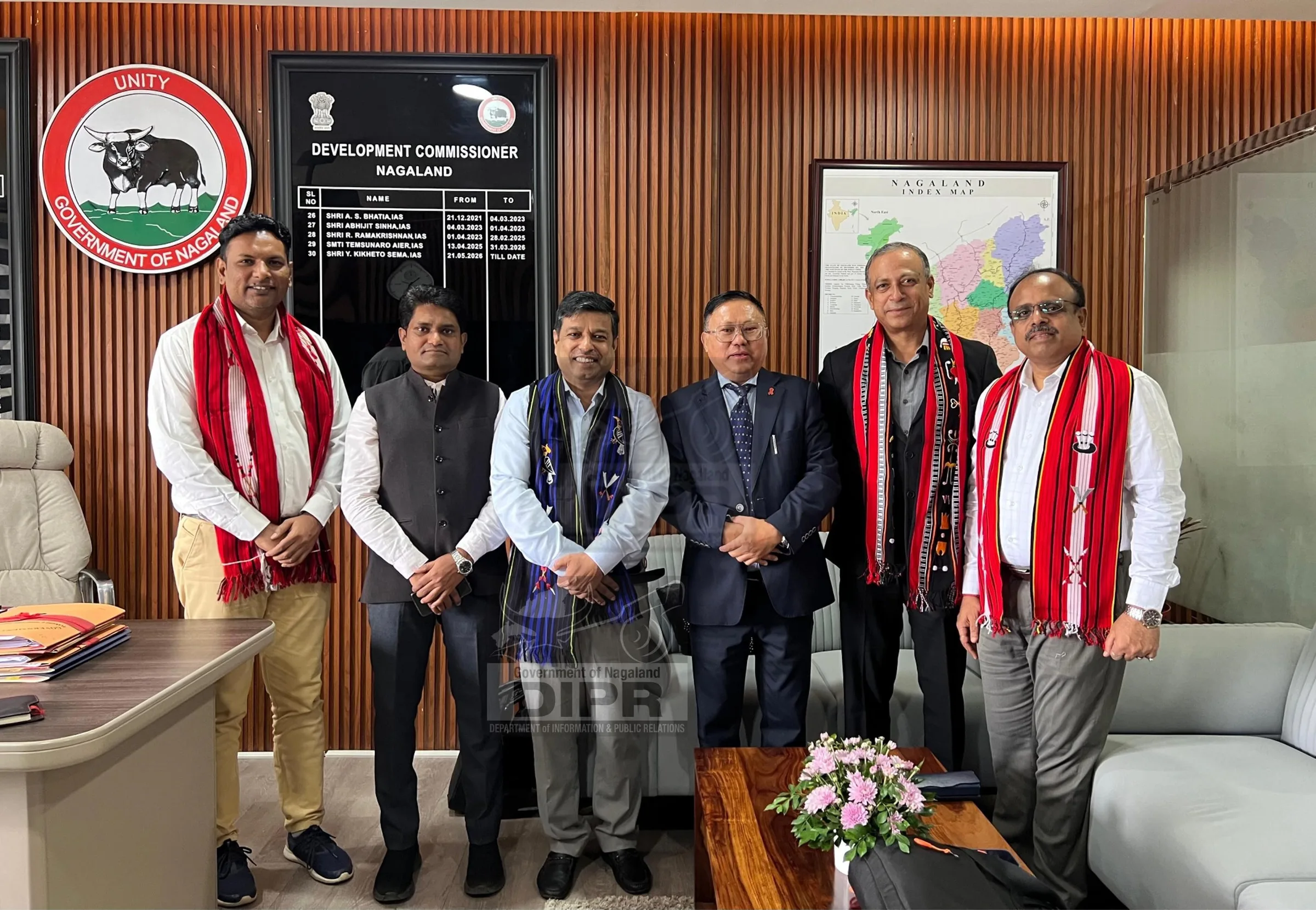
A coordination meeting with scientists from the Indian Council of Forestry Research and Education (ICFRE) institutes was held at the Nagaland Civil Secretariat, Kohima on November 11, 2026.
The meeting was chaired by Y. Kikheto Sema, IAS, Principal Secretary and Development Commissioner, at his office in the Nagaland Civil Secretariat Conference Room.
A team of scientists from ICFRE-Institute of Wood Science and Technology (IWST), Bengaluru, ICFRE-Institute of Forest Biodiversity (IFB) and ICFRE-Rain Forest Research Institute (RFRI), Jorhat, conducted field visits to various areas of Nagaland on November 10, 2026, to assess the growth of the two tree species, heartwood development in mature trees and the suitability of the State’s soil and climatic conditions.
During the meeting, Dr. Swapnendu Pattanaik, Director, IFB; Dr. B. N. Diwakara, Scientist-F, IWST, Bengaluru; Dr. Satyam Bordoloi, Scientist-E, RFRI; and Dr. Rakesh Kumar Prajapat, Scientist, RFRI, presented their findings and shared technical assessments on the cultivation potential of Sandalwood and Red Sanders in different parts of the State.
The scientists observed that the foothill areas of Nagaland, with favourable moisture conditions and fertile soil, offer encouraging prospects for Sandalwood cultivation. Heartwood development in mature trees was also found to be satisfactory, indicating good potential for its cultivation. Positive findings from scientific studies in adjoining areas of Diphu were also presented in support of the assessment.
However, the scientists emphasised the need for scientific cultivation practices, including the use of quality planting materials, appropriate spacing and suitable host plants, as Sandalwood is a parasitic species that depends on host plants for its growth and survival. Considering its relatively long gestation period, they recommended cultivating Sandalwood on land that is not suitable for other commercial crops.
With regard to Red Sanders, the scientists observed that although the physical growth of the trees is impressive under Nagaland’s climatic conditions, heartwood development remains slow and has not attained the quality required for commercial purposes. They therefore advised the Department to exercise caution while recommending the species to farmers and suggested further technical studies.
Based on the findings, Sema directed Department officials to undertake training and awareness programmes to educate farmers on scientific Sandalwood cultivation, develop appropriate schemes and work towards formulating a long-term policy for its cultivation and trade in the State.
Highlighting the potential of Sandalwood alongside other commercial crops such as coffee, rubber, agarwood and teak, Sema said commercial tree cultivation could create employment opportunities in rural areas and contribute to strengthening the State’s economy.
He stressed the need for farmers to understand the science behind cultivating long-gestation plantation crops such as Sandalwood and Red Sanders before committing their limited land resources. He also urged them to follow the recommended package of practices and technical guidance provided by scientific institutions and the Department to ensure ecologically sustainable and economically viable cultivation.
Cautioning farmers against exaggerated claims and false promises made by commercial nurseries, Sema emphasised the importance of procuring quality planting materials and relying on scientifically validated information before undertaking commercial plantations.
(Esuihangle, IA)