
Photo News · Kohima
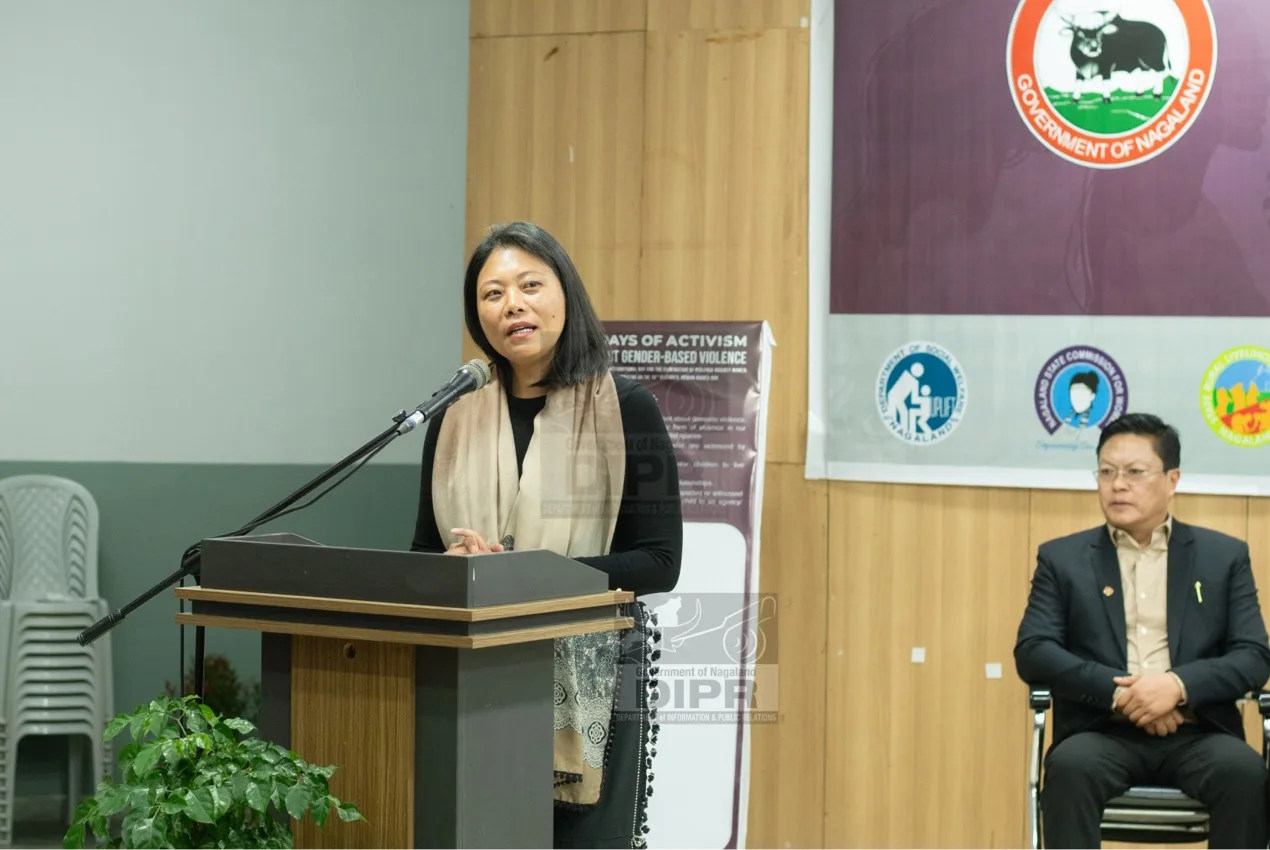
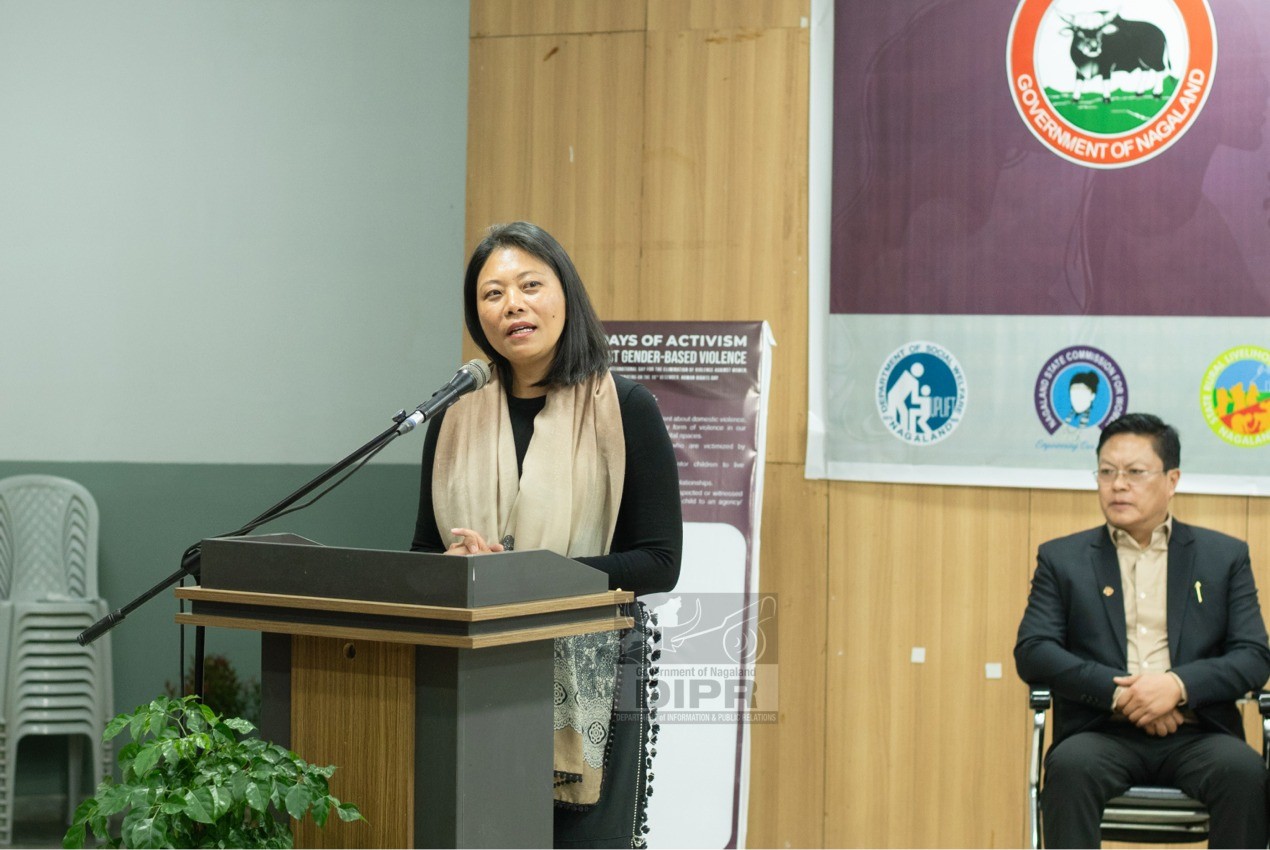
“We must establish a culture of zero tolerance towards violence against women in our state,” said Hekani Jakhalu Kense, MLA and Advisor, Industries & Commerce, in her address at the State-level observation of the International Day for the Elimination of Violence against Women, held at the Capital Convention Centre, Kohima, on 25th November 2026, under the theme, “UNiTE to End Violence against Women and Girls: Ensure Justice, Protect Survivors, End Impunity.”
Addressing the gathering, Jakhalu emphasized that before discussing how to ensure justice, protect survivors, or end impunity, society must first grasp the true magnitude of the problem. Citing the World Health Organization and UN Women, she pointed out that one in every three women experiences violence during her lifetime, making gender-based violence one of the most pervasive human rights violations worldwide.
While statistics may suggest that Nagaland is one of the safest places for women, she noted that these figures do not necessarily reflect the ground reality. The biggest challenge, she said, is the normalisation of harassment, violence and abuse, which society has come to treat as ordinary occurrences.
Pointing out that violence takes many forms, she observed that while some incidents occur in public spaces, domestic violence remains a silent epidemic behind closed doors. Many cases go unreported due to societal expectations, fear of ostracization, and the belief that domestic matters should remain private. Such incidents rarely happen in isolation, as families and neighbours are often aware of the abuse yet hesitate to intervene. “We cannot keep waiting for something irreversible to happen before we act,” she asserted.
She mentioned that patriarchal structures further aggravate the problem, with women often pressured to endure abuse for the sake of family honour. Divorce remains highly stigmatised, and women who leave abusive marriages are frequently shamed rather than supported. Many remain trapped in toxic relationships due to economic dependence, concerns about their children or fear of social backlash.
She also highlighted the tendency to question victims rather than hold perpetrators accountable, with society often asking, “What was she doing? Why didn’t she report it?”. Victims may remain silent due to fear of further harm, retaliation, loss of privacy, social judgement or the belief that reporting abuse will make no difference.
Stressing that abuse and trauma have lasting consequences, she said they affect survivors’ emotional well-being, relationships and sense of self, and can increase the risk of anxiety, depression, self-harm and even suicide.
Drawing attention to the scale of the problem, she said that if Nagaland has an estimated population of 20 lakh, with women constituting around 10 lakh, one-third would amount to approximately three lakh women who may experience some form of violence during their lifetime. She urged society to reflect on what this means for the status of the state and the well-being of its people.
She said the programme should not be treated merely as a one-day event to mark the International Day for the Elimination of Violence against Women, but as an opportunity for serious reflection and sustained action from every section of society.
Emphasising that addressing violence against women is not the responsibility of the government alone, she said that the church, civil society organisations and every individual must also take responsibility. While acknowledging the church as the moral and ethical backbone of communities, she observed that religious institutions sometimes remain silent or prioritise family unity at the cost of women’s well-being.
She also stressed the need for continuous awareness campaigns to educate women about their legal rights and encourage them to report abuse without fear of stigma.
Concluding, she called for a collective effort from every stakeholder and section of society to stop normalising harassment, violence and abuse against women and children.
Delivering the keynote address, Secretary, Social Welfare, Limawabang Jamir, IAS, said violence against women and girls continued to be a serious human rights concern, affecting women across age groups, geographical boundaries and socioeconomic backgrounds. He highlighted the initiatives undertaken by the Ministry of Women and Child Development under Mission Shakti, including the Hub for Empowerment of Women, Beti Bachao Beti Padhao, One Stop Centre (OSC) and Women Helpline 181.
He informed that since the establishment of the first Sakhi One Stop Centre in 2016 till October 2026, the One Stop Centres in the state had addressed 2,121 cases of gender-based violence, while Women Helpline 181 had attended to 3,568 cases involving gender-based violence and information-seeking calls.
Marking the 10th anniversary of the One Stop Centres in Dimapur and Kohima and Women Helpline 181, he appreciated the teams for their dedicated service to women over the past decade. He also called upon students to contribute towards preventing gender-based violence through peer-led initiatives, digital safety awareness and reporting mechanisms, while encouraging survivors to seek support through available services.
Jamir also congratulated NSRLM on the launch of three additional Gender Resource Centres in RD blocks of Dhansiripar, Jalukie and Shamator and the fifth edition of Nayi Chetna under the Deendayal Antyodaya Yojana–National Rural Livelihoods Mission.
In her concluding remarks, Chairperson, Nagaland State Commission for Women, W. Nginyeih Konyak, called for translating awareness into tangible action in homes, educational institutions and communities. She urged students to stand against cyberbullying, harmful stereotypes and peer pressure, and encouraged women to know their legal rights, pursue financial independence and seek support through institutions such as NSCW, One Stop Centres and Women Helpline 181.
Stressing the need for stronger institutional coordination, she said that no single agency could address gender-based violence, human trafficking and cybercrime independently. She called for coordinated efforts among the Commission, Social Welfare Department, Mission Shakti, One Stop Centres, law enforcement agencies, District Legal Services Authorities and NSRLM to ensure a survivor-centred approach that upholds confidentiality, dignity and timely justice.
Konyak also highlighted the need for greater women’s representation in decision-making platforms, community leadership and economic enterprises, adding that safeguarding women’s rights required collective vigilance from men, community leaders, civil society organisations and young people.
The programme also featured the release of an awareness video and the anniversary special edition of the Sakhi One Stop Centres, Dimapur and Kohima, and Women Helpline 181 newsletter, highlighting 10 years of service. It was informed that more than 30% of cases reported to the One Stop Centres involved domestic violence.
The programme further featured the launch of the 16 Days of Activism against Gender-Based Violence, Nayi Chetna 5.0, and three Gender Resource Centres, followed by a pledge-taking and signature campaign led by OSD/Additional Director, Social Welfare, Imkongzenla.
Earlier the programme was chaired by State Programme Manager, NSRLM, Khriezovonuo Lhoungu. Invocation was pronounced by Keduoneituo Yhome, Pastor, Phezoucha Baptist Church.
The programme was jointly organised by Mission Shakti under the Department of Social Welfare, Nagaland State Commission for Women (NSCW) and Nagaland State Rural Livelihoods Mission (NSRLM). The occasion also marked the launch of the 16 Days of Activism against Gender-Based Violence and Nayi Chetna 5.0.
(Malungnenla, IA)