
Photo News · Kohima
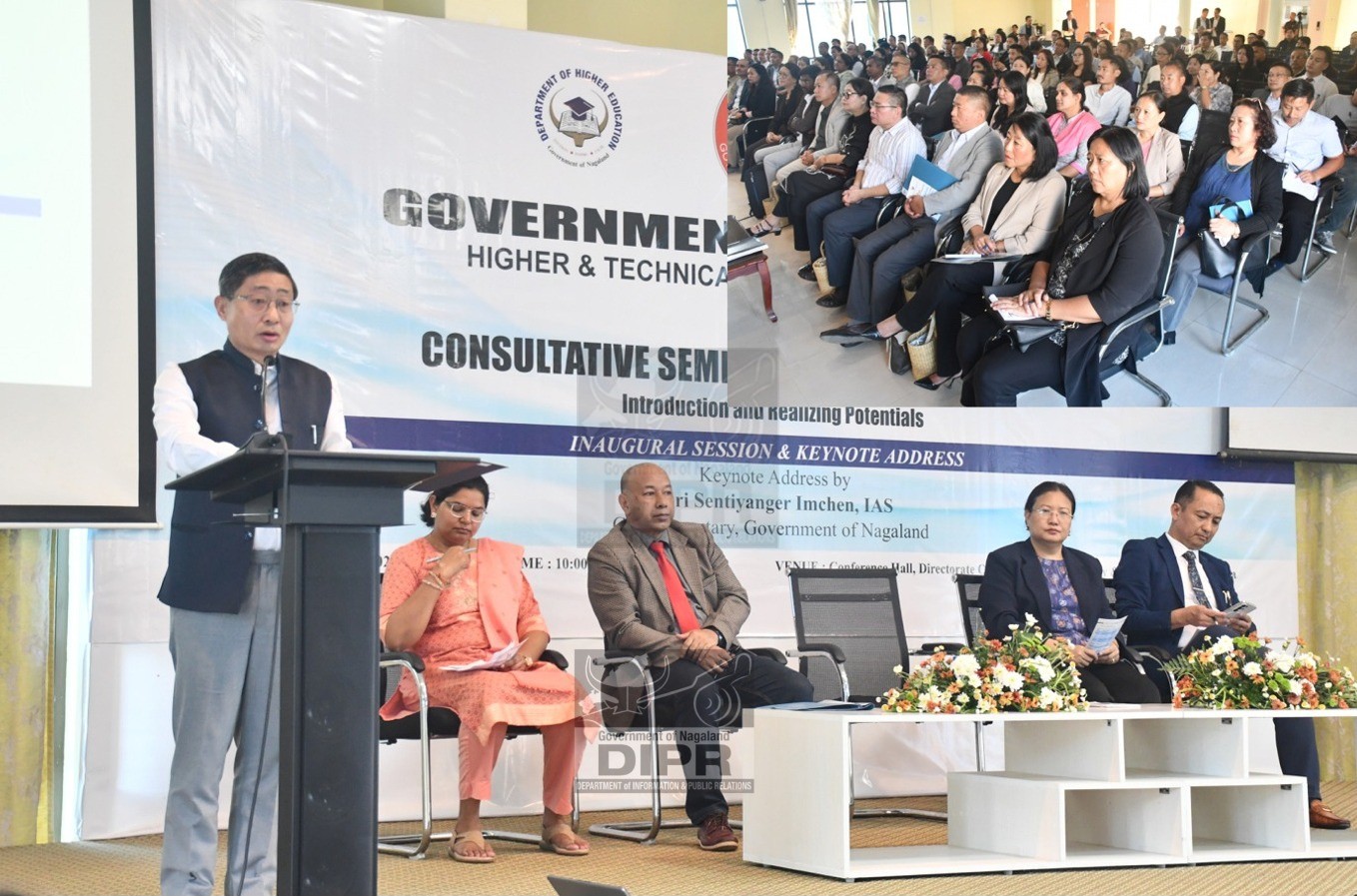
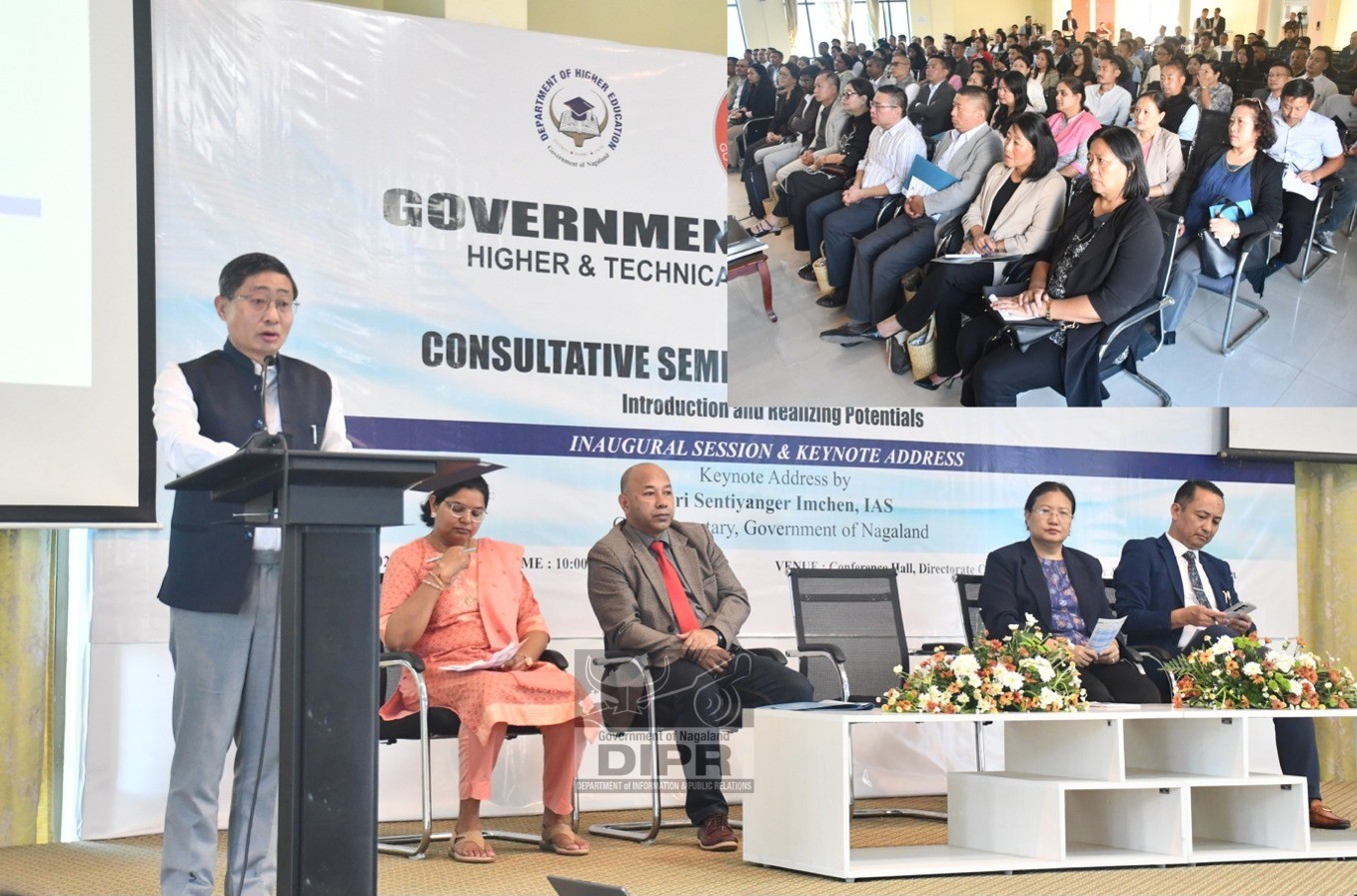
A one-day consultative seminar on “Emerging Trends: Introduction and Realising Potential” was organised by the Department of Higher & Technical Education at the Conference Hall of the Department of Information Technology & Communication on 30th October 2026.
Delivering the keynote address, Chief Secretary, Sentiyanger Imchen, IAS, stated that societies and institutions continuously evolve and progress, and education and educational institutions are no exception. He said the landscape of education was undergoing its fastest transformation since the Industrial Revolution, driven by technology and changing economic demands.
He stated that key global drivers, including rapid technological disruption, climate change, demographic shifts and the green transition, were bringing about structural changes in higher and technical education globally. He added that premier Indian institutions, including IITs, NITs and IIMs, were also preparing graduates for high-growth technical domains.
He highlighted that, for decades, global education systems had maintained a strict hierarchy in which academic tracks leading to universities were considered prestigious, while vocational tracks leading to trades were viewed as secondary. This emphasis on academic education had created a paradox, with many university graduates possessing theoretical knowledge but facing unemployment due to a lack of practical skills required by employers, resulting in what is known as the skills gap. He stated this was the situation the State was facing today.
On the integration of emerging courses in higher education institutions (HEIs) in India, he stated that three major structural trends were evident: technology-driven disciplines, the green and sustainability transition, and interdisciplinary and applied professional courses.
He highlighted that technology-oriented programmes such as B.Tech., M. Tech. and Ph.D. in Data Science and Artificial Intelligence (DS&AI), Cybersecurity, Digital and Forensic Sciences, FinTech and Digital Marketing were expanding across universities and specialised institutions. Similarly, programmes in Energy Science, Renewable Energy and other sustainability-related fields were gaining prominence in response to emerging industry requirements and the transition towards a green economy.
He stated that these trends indicated that India’s leading higher education institutions were proactively responding to global labour-market shifts by incorporating emerging disciplines into formal academic structures. These disciplines were increasingly becoming mainstream components of India’s higher education system, strengthening its capacity to respond to evolving skill requirements, technological advancements and employment opportunities.
On the relationship between education and the labour market, he stated that it was a dynamic supply-and-demand relationship in which educational institutions build human capital, while the economy determines how those skills are valued, absorbed and rewarded. He emphasised that education alone did not automatically guarantee employment, as a disconnect often existed between what academic institutions produced and what industries required.
He said the global labour market was undergoing structural transformation driven by rapid technological innovation and digitalisation. The World Economic Forum’s Future of Jobs Report 2025 projected that, by 2030, labour-market demand would increasingly converge around digital technologies, artificial intelligence (AI), automation and sustainability-oriented skills. High demand was expected for AI specialists, machine learning engineers, data analysts, big data specialists, cybersecurity professionals, information security analysts and network specialists.
Speaking on the employment scenario in Nagaland, he said the State had always placed a premium on education, with parents often securing loans to educate their children, primarily with the hope of securing government employment. However, government jobs had become saturated, with recruitment into State Government services through the NSSB and NPSC standing at 845 persons in 2024 and 589 in 2025, highlighting the limited government employment opportunities available relative to the potential job-seeking population.
Referring to the Periodic Labour Force Survey (PLFS), March 2026, he stated that the unemployment rate in India for the 15–59 age group stood at 3.5%, compared to 7.3% in Nagaland. Youth unemployment among those aged 15–29 stood at 9.9% nationally, compared to 17.5% in Nagaland.
He further highlighted that Unemployment, Skill and Migration in Nagaland 2025 revealed that 92% of Nagaland’s residents lacked formal vocational or technical education, while 78% of workers had no prior work experience. He said these figures highlighted a critical gap between theoretical academic learning and practical job-market readiness.
On the way forward, he stated that it was encouraging that Nagaland University had taken the initiative to incorporate AI components into postgraduate and Ph.D. programmes across several departments, with implementation proposed from the 2026–2027 academic session. He urged private universities, colleges and technical institutes in the State to follow suit and incorporate emerging disciplines into their courses.
He also urged Nagaland University, private universities and colleges to take further initiatives to establish specialised departments and introduce emerging, industry-relevant programmes. He stated that faculty shortages and infrastructure constraints should not become stumbling blocks, and suggested exploring faculty-sharing arrangements, institutional collaborations, industry partnerships and hybrid learning to facilitate implementation.
He expressed hope that the seminar would serve as a catalyst for a paradigm shift in Nagaland’s education system, translating awareness into concrete institutional action. He urged representatives from universities, colleges and polytechnics to take responsibility for reviewing existing curricula, introducing future-oriented and industry-aligned programmes, and strengthening practical learning, research, innovation and entrepreneurship.
In her welcome address, Secretary of Higher and Technical Education, Sarita Yadav, IAS, stressed the need for educational institutions to keep pace with emerging technologies, changing industry requirements and evolving career opportunities. She highlighted the importance of informed academic choices and creating awareness among students about future career prospects. She said the seminar would provide a platform for sharing knowledge and exchanging ideas, and encouraged participants to apply the insights gained during the discussions in their respective institutions.
Delivering the special address, Pro Vice-Chancellor of Nagaland University, Medziphema Campus, Prof. Dipak Sinha, congratulated the State Government for organising the programme and highlighted the importance of introducing emerging courses in higher education institutions.
He stated that emerging courses need not always be entirely new programmes but could also involve updating existing curricula in response to changing technology and market demands. Highlighting the importance of AI, he said it should be incorporated across disciplines and not restricted to computer science only.
He informed that Nagaland University had started introducing AI-related courses and suggested a phased approach through short-term certificate courses in areas with employment potential. He also encouraged institutions to use the SWAYAM online learning platform, stating that around 70 undergraduate and 30 to 35 postgraduate students of the University had completed courses through the platform and transferred the credits to their academic records.
Highlighting opportunities in agriculture and allied sectors, he informed that Nagaland University had approved five agriculture-related skill enhancement courses. He also suggested faculty training programmes to help general colleges introduce such courses.
Stressing the importance of career guidance, practical learning and entrepreneurship, he called for greater industry exposure and institutional collaboration through the sharing of expertise and resources, and encouraged students to explore international scholarships and fellowships.
He concluded by emphasising that emerging courses should be supported by practical training and career guidance to prepare students for future employment opportunities.
The programme also featured technical sessions on various emerging fields. Assistant Professor Dr. M. Prakash spoke on green energy, renewable and sustainable energy, while Pro Vice-Chancellor of Nagaland University, Medziphema Campus, Prof. Dipak Sinha, delivered a session on agriculture, veterinary sciences and livestock.
Joint Director, NIELIT, Er. Morimenba, spoke on Artificial Intelligence (AI), Machine Learning (ML), Internet of Things (IoT), smart technologies, cybersecurity, semiconductors and data science engineering. Deputy Director of Health & Family Welfare, Dr. S. Yingnei Konyak, delivered a session on medical science technologies, while Principal, SCTE, Dr. Alemla Longkumer, spoke on emerging pedagogies in arts and commerce.
The programme concluded with remarks and an action plan by the Additional Secretary and Ex-Officio Director of Higher Education Department.
(Kazuhito, IA)