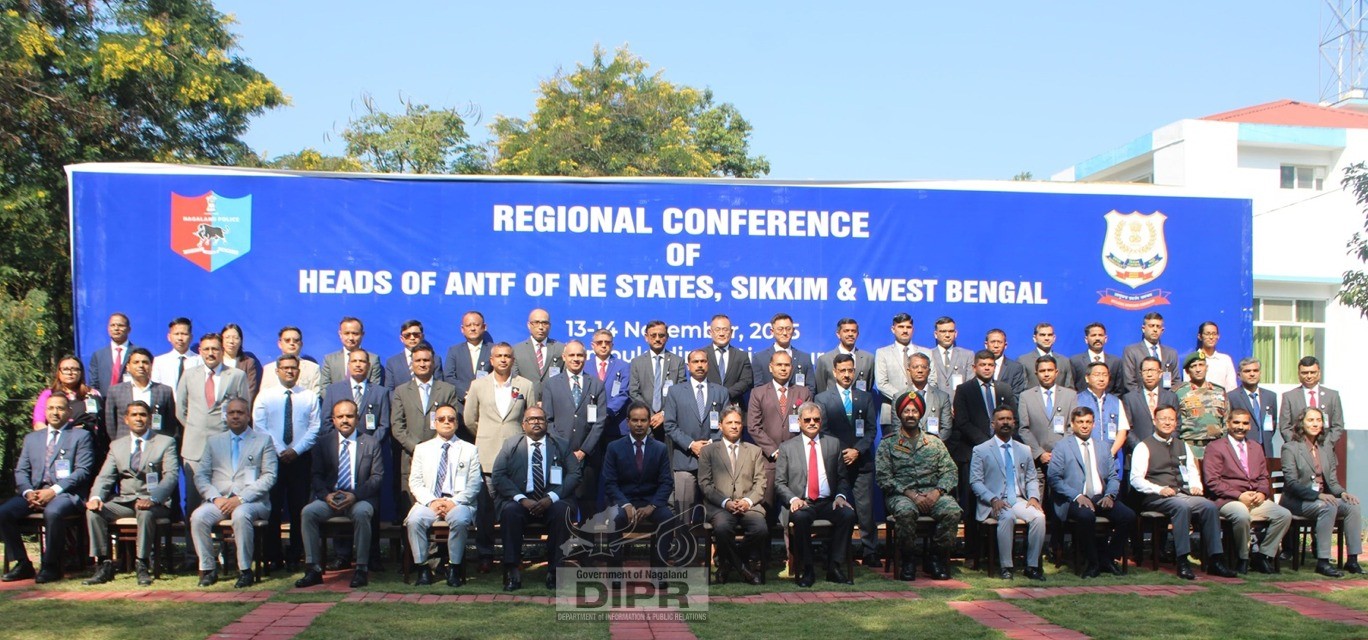
The Regional Conference of Heads of Anti-Narcotics Task Force (ANTF) of North Eastern States, Sikkim and West Bengal was held on 13th November 2025, at Police Complex, Chumoukedima. The two-day Conference aims to strengthen coordination and develop effective strategies to curb drug trafficking and substance abuse across the region. The inaugural session began with a welcome address by R. Sudhakar, IPS, DDG (NER), NCB. He extended a warm welcome to all the participants and emphasized the need for constructive discussions in formulating effective strategies and a comprehensive roadmap to tackle the drug problem in the North-East, viewing the conference as an opportunity for States to unite in this common cause.
While delivering the keynote address, Director General of Police, Nagaland, Rupin Sharma, IPS, stated that the long and porous 1,643 km border with Myanmar, combined with challenging terrains and the governance turmoil in Myanmar, and its close proximity to the Golden Triangle (Myanmar -Laos- Thailand) makes the north-east states, including Nagaland, extremely vulnerable. Drug trafficking and use are no longer merely law-and-order issues but they are a direct threat to our internal security and the future of our youth, he added.
The drugs and drug-money flowing through these routes feeds the nexus of organized crime, insurgency, and narco-terrorism, therefore dismantling the drug cartels, is synonymous with enhancing national security.
He informed that Nagaland has an estimated 1.2 lakh drug users who consume heroin locally known as 'shaanflower' or 'SF' because of its traditional origins in the Shaan province of Myanmar.
For this conference, he proposed focusing on three key pillars: Co-ordination, Enforcement, and Accountability. Coordination among agencies, Coordination among the various pillars of the criminal justice system, Coordination between law-enforcement and civilian wings of government with the public.
The DGP advised the law enforcement agencies to urgently scale up capabilities in communication surveillance, communications analysis through CDR and IPDR analysis, darknet analysis, crypto currency tracking, and digital forensics. He recommended the establishment of a dedicated Northeast Anti-Drug Trafficking Agency, which would serve as a nodal point at the regional level, facilitating inter-state intelligence, managing border surveillance, and overseeing rehabilitation programs, with a Director General at the helm. He also recognized the urgent need to strengthen the forensic infrastructure with new forensic labs, mobile units, and advanced technology upgrades—such as DNA profiling and mass spectrometry for swifter and more reliable drug analysis.
He proposed the launching of the “Nasha Mukt Bharat Helpline and Reward System", which provided a 24/7 platform for anonymous reporting of drug activities, with multi-lingual support and financial rewards for information leading from small dealer arrests to dismantling major trafficking cartels. He also advocated for comprehensive legal reforms under the NDPS Act.
Sharma reiterated that the solution lay in multi-agency coordination, targeted investments, and sensitive handling of unique regional concerns. He said that the police and other agencies present in this conference are not just the representatives of the law enforcement community, but are also the country's frontline defenders against a menace that threatens the very fabric of our society: the narcotics trade. He concluded his address with a call for collective action, cross-border cooperation, and the unwavering pursuit of a drug-free future for the Northeast and all of India.
Director General, Narcotics Control Bureau (NCB), Anurag Garg, IPS, in his address, highlighted the significance of coordinated efforts among the North Eastern states to strengthen enforcement mechanisms and intelligence sharing in the fight against narcotics. He said that the Drug trafficking generates other organized criminal activities and has serious public health and safety consequences, leading to increased crime, violence, and strain on healthcare systems. He stated that a 2019 survey conducted by the Ministry of Social Justice and Empowerment (MoSJE) showed higher rates of drug abuse in North Eastern states as compared to the other states of the country. He informed the gathering that The Narcotics Control Bureau (NCB) has designated state-level Anti-Narcotics Task Forces (ANTF) in all the States and Union Territories of the Country as the first line of defense in the fight against the drug menace. He said that the major influx of heroin and other narcotic drugs into the North Eastern states are from Myanmar and some insurgent organizations, and organized criminal groups in the region are involved in drug production and other illicit activities.
He outlined key discussion points to be deliberated during the conference such as ways to target drug kingpins, inter-agency integration and real-time intelligence sharing, addressing the issue of opium and cannabis cultivation, on utilizing digital platforms for intelligence, and improving prosecution of narcotics cases. He encouraged all the participants to utilise the conference to foster mutual understanding, trust, and empathy among the different agencies for better coordination and collaboration in the fight against drugs.
The Conference was attended by officials from the Narcotics Control Bureau (NCB), Ministry of Social Justice and Empowerment (MoSJE), and police departments from all the North- Eastern states, Sikkim and West Bengal.
(Samuel, IA Chumoukedima)