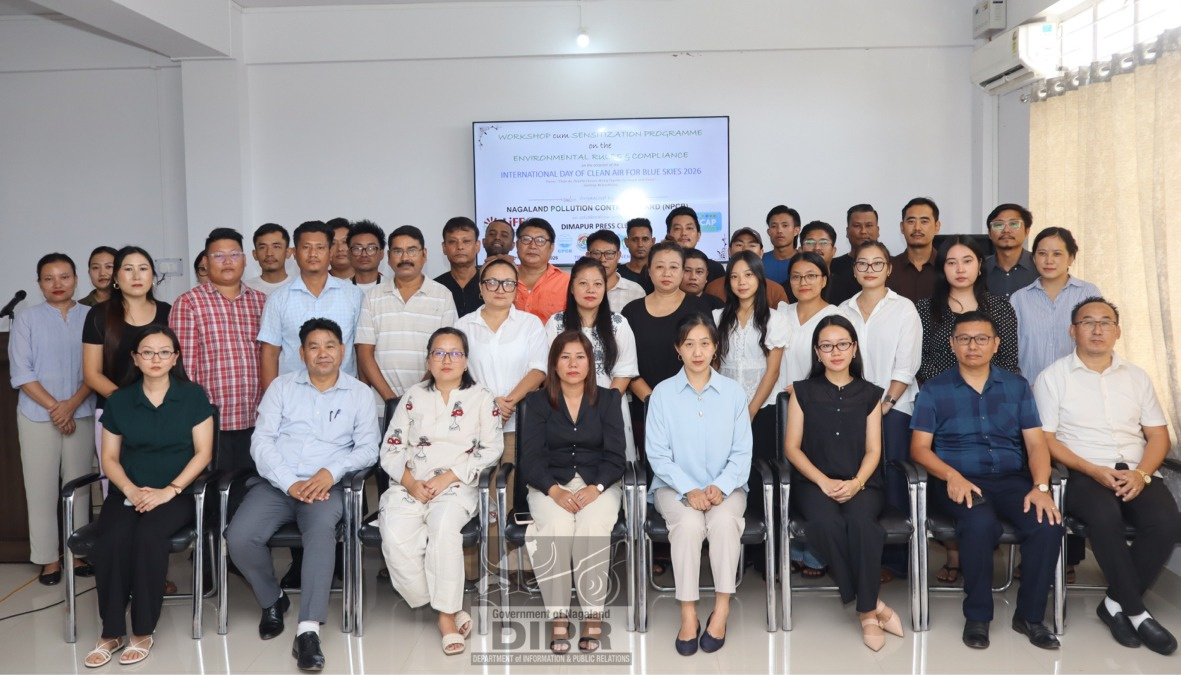
The Nagaland Pollution Control Board (NPCB), in collaboration with the Dimapur Press Club, organised a Workshop-cum-Sensitisation Programme on Environmental Rules and Compliance in observance of the International Day of Clean Air for Blue Skies 2026 at the Conference Hall of the Nagaland Pollution Control Board, Signal, Dimapur, on September 7, 2026.
The programme was held under the theme “Clean Air, Healthy Choices: Acting Together for People and Planet”, with Clean Air Day as the hashtag. The workshop aimed to sensitise participants on environmental regulations, pollution control measures and compliance with various waste management rules, besides promoting greater awareness and collective action towards clean air and a healthier environment.
The inaugural session commenced with an invocation by Ruth, Scientific Assistant, NPCB, followed by a keynote address by Er. Aghali A. Swu, Senior Environmental Engineer, NPCB. In her keynote address, Swu highlighted the growing threats posed by air pollution and climate change. Speaking on environmental rules and compliance, she stressed that environmental protection must be treated as a shared responsibility of the government, media and public. She stated that, air pollution had emerged as one of the major health risks in India.
Referring to the World Health Organization, she said nine out of 10 people globally breathe polluted air, while stressing that pollution knows no boundaries and can affect agriculture, water resources, soil and the climate.
She also drew attention to groundwater depletion and erratic rainfall, which were increasingly affecting farmers and livelihoods in different parts of the country. “Climate change is really happening faster than we ever imagined,” she said, calling for collective efforts to address environmental challenges before they become irreversible.
She underlined the important role of the media in educating the public and creating awareness on environmental and climate-related issues. She also urged media professionals to remain updated on emerging environmental challenges as well as various waste management rules to ensure accurate and effective reporting. She further informed environmental reporting could help communities better understand the impact of pollution and encourage responsible practices in waste management and environmental protection.
Vice President of the Dimapur Press Club and Reporter, Nagaland Post, Bendangchuba Kichu, in his address called for stronger collaboration between the media fraternity and environmental authorities to improve environmental reporting and create greater public awareness on pollution and environmental protection. He said environmental issues often receive less media attention compared to politics, law and order, and government programmes. He observed that environmental issues frequently become news only during disasters such as floods and landslides, making media coverage largely reactive rather than proactive.
“We often report extensively on politics, law and order and government programmes, but when it comes to the environment, our coverage is not enough,” Kichu said, adding that there was a need to change this approach.
He identified the lack of easily accessible and understandable data, the perception that environmental issues constitute “soft news” and limited training among journalists in interpreting environmental laws, pollution data and scientific reports as some of the reasons for inadequate environmental coverage.
Kichu stressed that journalists have a responsibility to explain how pollution affects people's lives and health. He said journalism should go beyond quoting international studies and reports and instead focus on local issues that people can easily understand and relate to. He cited issues such as the impact of air pollution on families in Dimapur, open burning of garbage near residential areas and dumping of waste into drainage systems as examples of stories that require greater attention.
Emphasising the media's role as both a watchdog and a bridge between authorities and communities, Kichu said journalists should question the administration when it fails to address environmental concerns, while also holding communities accountable when they contribute to environmental degradation.
He said a meaningful partnership between the NPCB and the media could help strengthen environmental awareness and reporting in the State. While the Pollution Control Board possesses technical expertise, scientific data and the legal mandate, the media has the reach to take information to communities, villages and colonies.
Kichu urged the Pollution Control Board to provide journalists with regular, simple and timely information on air quality, pollution hotspots, water quality, major environmental violations and basic environmental dos and don'ts.
Such information, he said, would enable journalists to translate technical data into meaningful human-interest stories and accessible news reports. He suggested regular environmental briefings, periodic reports and field visits for media persons as ways to build a continuous partnership between the environmental authorities and the media.
“Let us not wait for the environment to become a crisis before we make it news,” Kichu said, stressing that environmental protection should be treated as a continuous public concern rather than an issue that gains attention only during disasters.
He added that while governments may change, a damaged environment could take generations to recover, making environmental protection a shared responsibility of the government, media and the public.
The first technical session covered ambient air quality and its impact, noise pollution and the Noise Pollution (Regulation and Control) Rules, 2000, and water quality and its impact. The session was followed by a discussion and interaction hour, allowing participants to seek clarification on various environmental concerns.
The second technical session focused on Hazardous and Other Wastes (Management and Transboundary Movement) Rules, 2016, Battery Waste Management Rules, 2022, E-Waste Management Rules, 2016, and Plastic Waste Management Rules, 2016. Officials of the NPCB served as resource persons for the session.
The third technical session dealt with the Bio-Medical Waste Management Rules, 2024, Solid Waste Management Rules, 2026, and consent management and environmental compliance of industries.
The programme concluded with a discussion and interaction session, followed by a vote of thanks proposed by Welunbo, Accounts Officer, NPCB.
The workshop provided an interactive platform for participants to gain a better understanding of environmental regulations and the need for collective responsibility in maintaining clean air and a sustainable environment.
(Tovikali, IA,Dimapur)