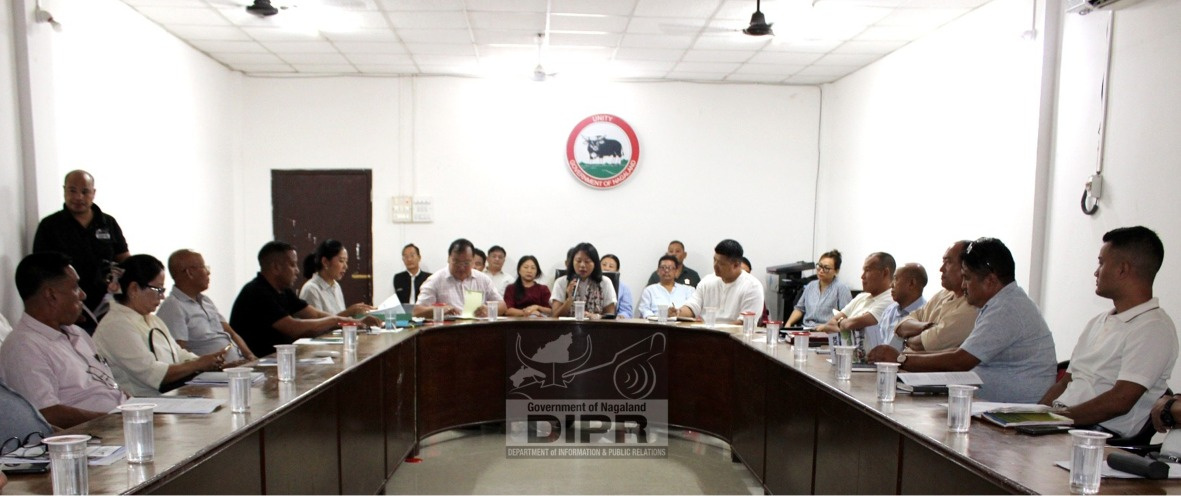
The monthly meeting of the District Planning & Development Board (DPDB), Dimapur, was held at the DC’s Conference Hall, Dimapur, on September 23, 2026. The meeting was chaired by Hekani Jakhalu Kense, Advisor Industries & Commerce, while Dr. Tinojongshi Chang, Deputy Commissioner & Vice Chairman, DPDB, Dimapur initiated the meeting.
Emphasising that sanitation is a shared responsibility, Advisor and Chairperson of DPDB, Dimapur, Hekani Jakhalu, called for collective action from government departments, urban local bodies and citizens to make Dimapur cleaner and healthier.
Jakhalu said maintaining sanitation was not solely the responsibility of the municipal councils or the government, but required community ownership. She urged government servants to go beyond their assigned duties and contribute towards improving cleanliness, particularly during the monsoon season when flooding and poor waste disposal become major concerns.
She noted that clogged drains and indiscriminate dumping of waste had worsened the city’s sanitation challenges, adding that the issue affected not only the environment but also public health and the quality of life. She appealed to all departments to make sustained efforts towards creating a cleaner district.
Deputy Commissioner Dr. Tinojongshi Chang, NCS, informed the meeting that under the Solid Waste Management Rules, the district administration had been entrusted with monitoring sanitation through monthly online reporting. He said segregation of waste at source remained below 10 per cent in the district and called upon all DPDB members to incorporate sanitation awareness in departmental programmes and village outreach activities.
The DC also proposed that Dimapur Municipal Council and East Dimapur Town Council, to make a presentation in the next DPDB meeting on waste management practices, challenges and measures required to improve segregation and achieve sanitation targets.
During the discussion on the Reform Utsav, a citizen-centric governance reform initiative, the Deputy Commissioner stated that the initiative aims to listen to citizens and prepare actionable reform plans through a bottom-up approach. He highlighted the need for awareness among all sections of society and greater participation of people at the grassroots level to bring forward their grievances and suggestions to the concerned departments.
The district-level activities would focus on awareness, bottom-up participation, implementation and delivery of services, commitment and monitoring, followed by action on the issues raised by citizens. Around 21 departments are involved in the reform process.
Dr. Diana Patton, ADC Dimapur explained that the campaign would officially commence on October 2 and continue through December. At the present stage, departments were carrying out awareness activities at the village and ward levels involving ward authorities, village councils, urban local bodies and educational institutions.
Departments were urged to coordinate their activities, share updates and photographs through the designated WhatsApp group and make optimum use of available resources, as no separate funding had been received so far. The initiative was also linked to the Sustainable Development Goals (SDGs), with departments encouraged to work collectively towards achieving the targeted development outcomes.
A proposal for district-wide verification, registration and joint inspection of private students’ hostels operating in Dimapur was also discussed. The discussion followed observations and recommendations submitted by a vigilance committee constituted under the Naga Council, Dimapur. The committee reportedly found lapses in some private hostels, including absence of clear operational guidelines, unrestricted movement of students and instances where boys and girls were accommodated within the same compound.
The District Education Officer (DEO) informed the meeting that there was currently no specific regulation under the School Education Department governing the establishment and operation of private hostels. Applications were processed through field verification and issuance of No Objection Certificates, but there was no systematic mechanism for maintaining records or conducting periodic inspections of hostels.
The DEO further stated that the department had already written to the Principal Director, School Education, seeking regulations for setting up private hostels. He suggested that verification of existing hostels would be useful, particularly as the number of such establishments had increased.
Members also highlighted concerns regarding the safety, supervision, hygiene and overall environment in private hostels, particularly those operating from buildings without adequate outdoor facilities. It was observed that parents entrusted hostel operators and teachers with the care of students and that proper guidelines were therefore necessary.
The meeting noted that district-wide inspection should be based on clear regulations and a standard checklist, rather than arbitrary assessments. It was suggested that the matter be forwarded to the concerned departments at the State level for formulation of comprehensive guidelines.
The DPDB decided to take up the matter with the concerned departments and work towards establishing appropriate guidelines for registration, verification and inspection of private students’ hostels in Dimapur.
The committee also discussed the need for proper verification of unions, societies and welfare organisations before registration, with a view to safeguarding small businesses and protecting public interest.
During the meeting, it was informed that the district administration had received representations regarding the registration of various unions and societies and their activities after registration. Officials observed that while many organisations fulfilled the existing requirements under the Society Registration Act, some organisations were reportedly engaging in activities beyond their stated objectives, affecting businesses and the general public.
The meeting noted that a number of applications were pending verification. Before forwarding applications for registration, officials were conducting field verification to ascertain whether the organisations were functioning properly and had genuine offices and activities.
Members also raised concerns over the mushrooming of unions and associations in different localities and the collection of various fees or charges from businesses. The need for clearer and stricter regulations was stressed to prevent misuse of registration provisions and protect businesses from unwarranted demands.
The Board also discussed the need for periodic renewal and verification of registered societies. It was suggested that clear guidelines and a uniform checklist be issued by the Home Department so that district administrations could follow standard procedures while processing applications.
The members stressed that genuine organisations should not be denied registration because of the activities of others. At the same time, stricter scrutiny and monitoring were considered necessary to ensure that registered organisations functioned according to their stated objectives.
The DPDB decided to recommend the matter to the Home Department, seeking clear directives and stricter conditions for the registration and renewal of societies and associations.
It was also suggested that organisations seeking registration in areas connected with specific departments should obtain a No Objection Certificate (NOC) from the concerned department wherever necessary. This, members felt, would help prevent duplication of organisations and ensure proper coordination with relevant departments.
Following a PowerPoint presentation on TB Mukt Bharat by the District Tuberculosis Officer, Dimapur, the ADC called for greater participation from government departments and all sections of society to support people undergoing TB treatment.
The ADC highlighted the need to strengthen efforts to identify and support TB patients, particularly in areas with a higher concentration of cases. She urged government officers to encourage their respective departments to participate voluntarily in the initiative and extend nutritional and other necessary support to TB patients.
During the discussion, Hekani Jakhalu suggested that the initiative should be taken up department-wise rather than limiting participation to officers attending the meeting. She urged Heads of Departments to discuss the initiative with their respective staff and encourage voluntary participation. She stressed that no one should feel pressured to contribute, but said that proper awareness and persuasion could encourage more people to come on board.
She also suggested that each department could identify interested members and compile their details so that the concerned coordinator could follow up and acknowledge their support. She said even if only a portion of the staff participated, the collective effort could help increase the number of supporters for TB patients.
The ADC informed that the initiative was open to government employees, elected representatives, business establishments, civil society organisations, churches, NGOs, youth and student groups, educational institutions, self-help groups and other organisations.
Contribution forms were distributed to facilitate participation. The minimum contribution was stated as Rs. 500 for a minimum period of six months. The officers were encouraged to take the initiative back to their respective departments and motivate staff to voluntarily support TB patients through nutritional assistance and other forms of support.
The meeting emphasised collective responsibility and wider community participation towards supporting TB patients and contributing to the goal of a TB-free India.
The DC also informed that a blood donation drive will be held at Emmanuel College on October 1, and anyone willing to donate blood is encouraged to participate. The college will facilitate and support those who wish to donate.
The DC also informed that the Government of India is selling subsidised onions at ₹35 per kilogram in Dimapur through MARCOFED (Nagaland State Cooperative Marketing and Consumers’ Federation Ltd.) in coordination with central agencies like the National Cooperative Consumers Federation (NCCF) and NAFED as part of the Price Stabilization Fund drive, he therefore requested the people to take the opportunity.
(I Tiakumla Ao, IA Dimapur)