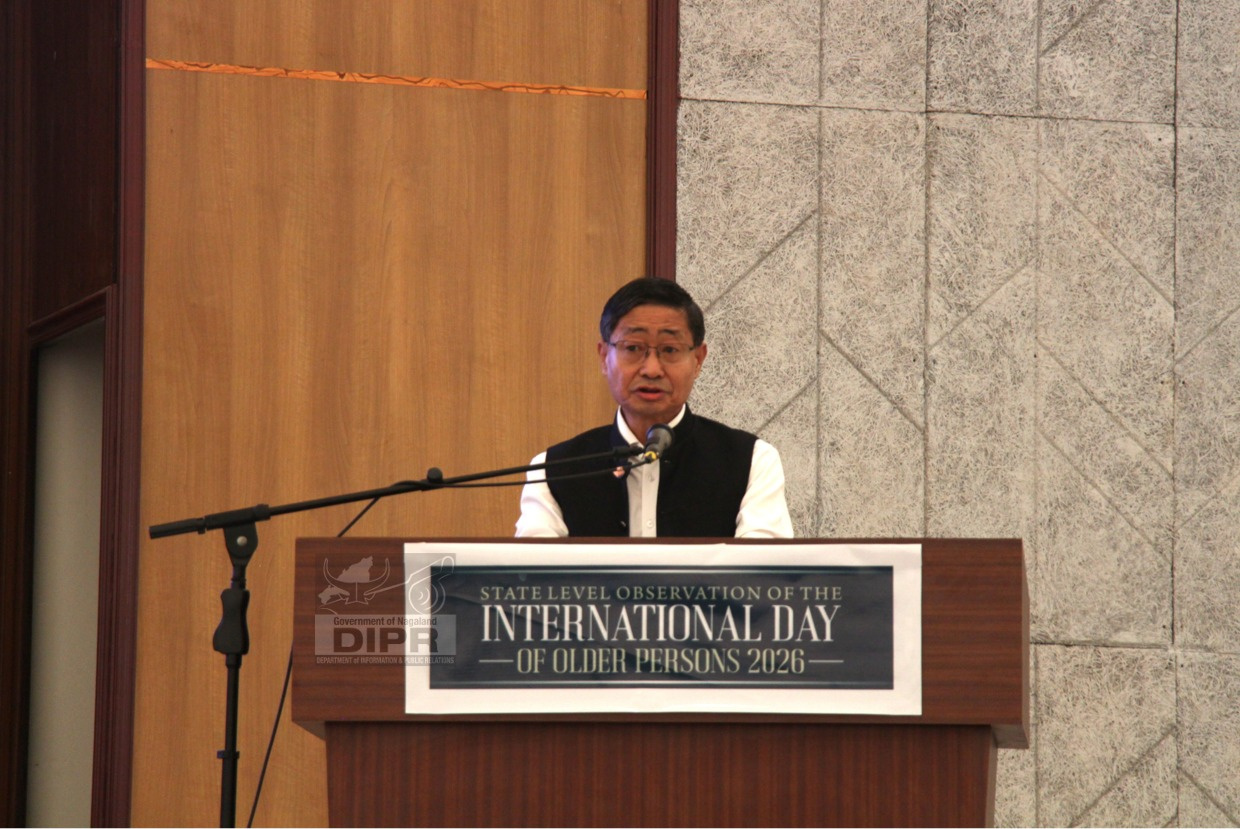
The State Level Observation of the International Day of Older Persons 2026 was held at the NBCC Convention Centre, Kohima, on October 1, with Chief Secretary Sentiyanger Imchen, IAS, calling for stronger systems and greater collective responsibility to ensure that longer lives are healthy, dignified, secure and meaningful.
The programme was organised by the Department of Social Welfare under the theme, “The Age of Longevity: Rethinking Systems for Longer Lives.”
Extending greetings to senior citizens across Nagaland, the Chief Secretary acknowledged their contributions and sacrifices in building the State, nurturing generations, strengthening institutions and preserving Nagaland’s unique identity. He said that in Naga society, elders have traditionally held a special place of respect, not merely because of their age but because of their experience and the accumulated wisdom of generations.
Referring to the changing demographic situation, Imchen said people are living longer than at any other point in human history, while fertility rates are declining in many countries. He said the longevity transition was not simply about an increasing number of older persons, but was changing the structure of families and communities and creating new challenges for healthcare and social security systems.
Citing the India Ageing Report 2023, published by UNFPA in collaboration with the International Institute for Population Sciences, he said India had approximately 149 million people aged 60 years and above in 2022, with the number projected to reach approximately 347 million by 2050. He said the changing situation required society to analyse, understand and address issues concerning the elderly with seriousness.
Highlighting government initiatives for senior citizens, the Chief Secretary said more than 63,300 senior citizens are currently receiving assistance through the Indira Gandhi National Old Age Pension Scheme (IGNOAPS) under the National Social Assistance Programme (NSAP) and State-supported pension initiatives.
On healthcare and social support, he said the Government, through the Department of Social Welfare and its partners, was strengthening healthcare support through health camps, cataract surgeries and other targeted interventions. Under the Rashtriya Vayoshri Yojana, eligible senior citizens from BPL families are provided assistive and mobility devices.
He also highlighted the strengthening of Geriatric Caregiver training in partnership with Christian Institute of Health Sciences and Research (CIHSR), Dimapur, and other expert training partners. He said the initiative would help improve professional care for the elderly while creating meaningful livelihood opportunities for the youth.
On institutional care, Imchen said the Government supports 12 Senior Citizen Homes under the Atal Vayo Abhyuday Yojana (AVYAY), providing safe and healthy environments where senior citizens can find companionship, recreational activities and medical supervision.
He also highlighted the Senior Citizens Helpline – 14567, a toll-free national helpline launched in Nagaland on September 28, 2021. The helpline provides information and guidance on pensions, government schemes and elder-care services, besides assistance in situations involving distress, vulnerability or abuse.
The Chief Secretary stressed that while policies and schemes were important, their proper implementation on the ground was equally essential. He said loopholes must be plugged, gaps bridged and outreach expanded. He appreciated the Department for taking up the identification of bogus and non-eligible beneficiaries under IGNOAPS in coordination with State treasuries, stating that the exercise would help extend the scheme to deserving beneficiaries who are yet to be covered. He appealed to the public to cooperate with the Government in the exercise.
Speaking on rethinking work, retirement and contribution, Imchen said families and communities have traditionally been Nagaland’s greatest strength, with elders cared for by children, grandchildren and relatives. However, he observed that education, employment, migration and changing lifestyles were making families more dispersed, placing the traditional support system under strain.
He called for families, communities, churches, Government and society as a whole to give serious thought to ensuring that the tradition of caring for elders continues in modern forms and that appropriate structures are put in place to meet the needs of senior citizens.
The Chief Secretary said longevity was a blessing but also required adjustment to changing circumstances. Retirement from employment, business or economic activity, he said, should not necessarily mean withdrawal from a productive and meaningful life. He encouraged senior citizens to remain physically active, health-conscious and engaged in community life.
Secretary, Social Welfare, Limawabang Jamir, IAS, in his keynote address, acknowledged the contributions of senior citizens at the State and district levels and said longer lives must be accompanied by a higher quality of life, safety and protection of human rights. He emphasised the need to strengthen healthcare systems, develop age-friendly workplaces and lifelong learning opportunities, improve accessibility and infrastructure, and protect the rights and dignity of older persons.
He also highlighted the participation of healthcare professionals, senior artisans, young students, civil society organisations and the Elderline 14567 team in the programme, noting that their involvement could help promote greater awareness and build age-friendly communities.
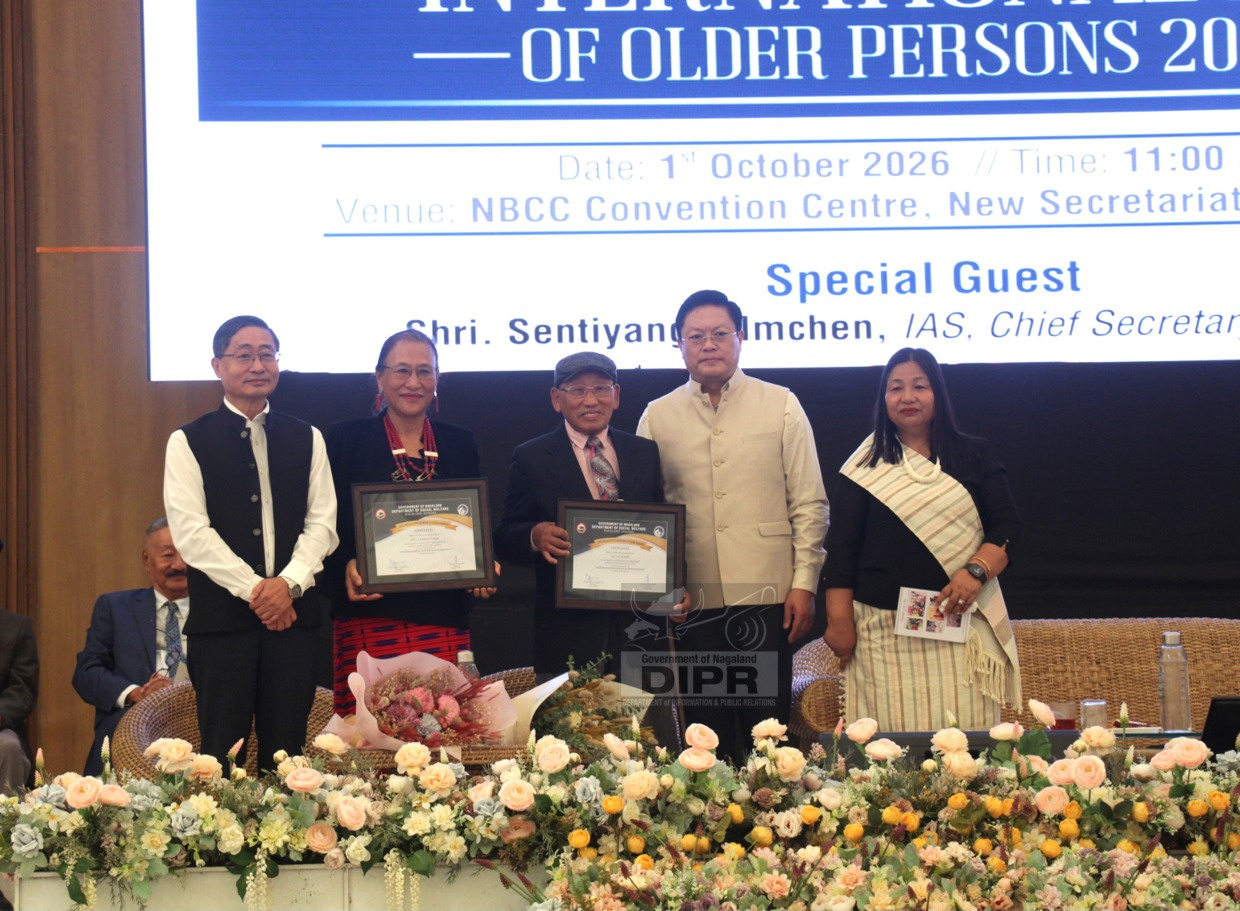
The programme also featured the presentation of State Awards to Prof. Alongla P. Aier, distinguished educationist, theologian, social worker and advocate for the empowerment of women and girls in Nagaland, and Dr. L.M. Murry, distinguished medical professional known for his contributions to medical service, humanitarian work, community welfare and Christian ministry.
Receiving the award, Prof. Alongla P. Aier expressed appreciation to the Centre and State Governments for observing the International Day of Older Persons and for recognising the elderly. She said respecting and recognising older persons was a valuable cultural practice that contributed to a more humane and dignified society. She also acknowledged the work of SCAN in ensuring that senior citizens are not forgotten and gave thanks to her family and, above all, to God.
Dr. L.M. Murry expressed gratitude for the recognition and thanked the Social Welfare Department for initiating the scheme. Reflecting on his life, he said experiences of happiness and difficulty had helped him grow in wisdom. He emphasised that while physical strength may diminish with age, experience and wisdom remain valuable, and expressed hope that these could continue to guide and encourage younger generations.
The programme also featured handicrafts by senior citizens and live demonstrations aimed at fostering inter-generational bonding. A free medical camp was organised by the Department of Health & Family Welfare, offering blood pressure and blood sugar checks, eye and ENT screening, dental check-ups, AYUSH services, general health check-up and consultation, along with CMHIS and ABHA registration.
The programme was chaired by Director, Social Welfare, Tosheli Zhimomi, while the invocation was offered by Rev. Izieteilung Terieng, State Chaplain, Nagaland Legislative Assembly. Assistant Director, Social Welfare, Akali Sema, presented the citations of the State Awardees and Deputy Director, Social Welfare, K. Wango Langsym, delivered the vote of thanks.
(Molungnenla, IA)