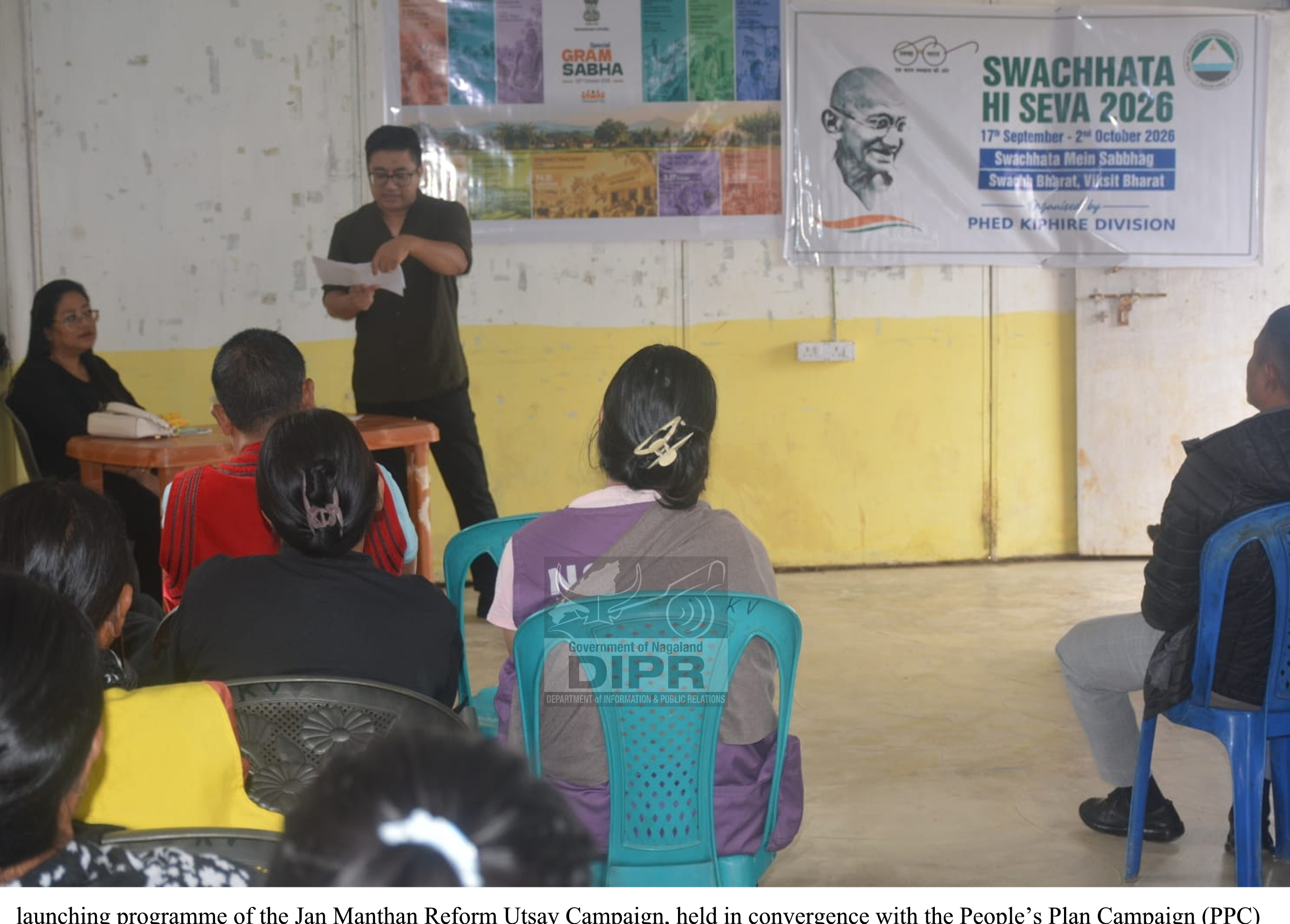

Reform Utsav integrated with the People’s Plan Campaign (PPC)-Gram Panchayat Development Plan (GPDP) was launched at Kuda Village (Nagarjan) in Dimapur district on October 2, 2026.
The programme, chaired by Jacob Zeliang, Block Development Officer (BDO), RD Block West Dimapur, focused on creating awareness about citizen-centric reforms, government schemes and services.
The launch featured a brief presentation on Reform Utsav by Lalen Phom, Department of Planning and Reformation, she stated that the initiative, launched nationwide on the call of the Prime Minister, seeks to identify reform suggestions from citizens and translate them into measurable outcomes as part of the broader vision of Viksit Bharat 2047. It emphasises a bottom-up, whole-of-government approach, with reform ideas cutting across departments rather than being confined to a single ministry. She highlighted three key features of Reform Utsav—time-bound and outcome-driven implementation, bottom-up participation, and a clear decision-making mechanism. Suggestions received from citizens would be tracked from collection through deliberation and implementation.
Phom said reform suggestion under the initiative would have to be general in nature, address a systemic root cause and propose a forward-looking change in policy, process or system. Unlike a grievance, which seeks redress for an individual case, a reform suggestion is intended to benefit all citizens facing a similar issue.At the State level, a State Level Coordination Committee (SLCC) has been constituted with the Chief Secretary, Government of Nagaland, as Chairman. Administrative Heads of Departments from key sectors including Home, Planning & Transformation, Power, Industries & Commerce, Social Welfare, Rural Development, Urban Development, Education, Health Engineering and others are members of the committee.
District administrations have been assigned a key role in taking Reform Utsav to the grassroots. They are expected to constitute District Level Committees and, where required, Sub-District Level Committees, coordinate with District Nodal Officers, and sensitise DPDB members and local institutions.
She said that awareness and mobilisation would involve Village Councils, Ward Authorities, schools, colleges, churches, SHGs, CSCs, MY Bharat volunteers and local media. District administrations would also conduct Gram Sabhas and town-level consultations to identify local service-delivery gaps that could be converted into systemic reform suggestions.
Help desks would be operationalised during outreach programmes to assist citizens in submitting suggestions through the Reform Utsav portal.
The Reform Utsav roadmap includes Jan Manthan, focused on discovering citizen inputs; Vimarsh, involving departmental deliberation and classification of suggestions; and Jan Samadhan, focused on delivering and implementing reforms.
The timeline includes citizen consultations and submission of suggestions from October 2 to 31, followed by department-wise compilation and examination of suggestions. During the Vimarsh phase, departments would examine and classify suggestions as quick-win or medium-term reforms, based on feasibility and departmental ownership.
The Jan Samadhan phase would involve implementation of quick-win reforms and preparation of roadmaps for medium-term reforms. Sankalp Siddhi, scheduled from December 25 to 27, would mark the culmination and reporting of achievements, followed by monitoring and Action Taken Reports from December 28 onwards.
Phom stated that the success of Reform Utsav would depend on converting citizen participation at the grassroots into practical systemic reforms and ensuring that suggestions did not remain merely as submissions but were followed through to implementation.
Departmental presentations on various citizen-centric reforms, schemes and services were also made by the Rural Development Department on PPC-GPDP, besides the Public Health Engineering Department (PHED), Social Welfare Department, Food and Civil Supplies, Veterinary Department and other line departments.
A brief presentation by Lakhpati Didi was also held as part of the programme.
The programme began with a welcome address by the Kevitsozie Liegise, VDB Secretary of Kuda Village and concluded with a vote of thanks by Apoung, Data Entry Officer RD under RGSA.
(Tiakumla.Ao IA Dimapur)