
Minister of Health & Family Welfare, Government of Nagaland, P. Paiwang Konyak launched the third round of the Intensified Information, Education and Communication (IEC) Campaign on HIV and Sexually Transmitted Infections (STIs) at Agri Expo, 4th Mile, Chümoukedima on August 12, 2026. Organised by the Nagaland State AIDS Control Society (NSACS) under the aegis of the National AIDS Control Organisation (NACO), the campaign was designed to strengthen awareness on HIV and STIs, encourage prevention and early testing, address stigma and discrimination and improve access to health services across the State.
Addressing the gathering as the Special Guest, Minister, Health & Family Welfare, P. Paiwang Konyak said that the launch of the campaign on International Youth Day was an opportunity to reaffirm the collective commitment towards safeguarding the health, dignity and future of the people of Nagaland. He said that young people were not merely leaders of the future but important partners in shaping the present, and stressed the need to invest in their health, knowledge and empowerment.
The Minister highlighted the HIV situation in the State and said that Nagaland continued to face a significant HIV challenge but at the same time, he pointed to the progress made through sustained prevention, testing and treatment efforts. He stated that since 2010, Nagaland had recorded a 39.97 percent reduction in new HIV infections and an 80.21 percent decline in AIDS-related deaths. He said the progress demonstrated that prevention, early diagnosis and uninterrupted treatment could make a significant difference.
Referring to the NACO HIV Estimation 2025, the Minister said that HIV prevalence varied across districts and therefore required locally appropriate responses. He acknowledged the support and leadership of the Government of India and NACO and said that the Mobilization for AIDS Suraksha (MAS) approach provided a framework for district-led, evidence-based and result-oriented interventions.
He said the first two rounds of the campaign had reached more than 1,300 village meetings, over 1,000 schools and 200 colleges, besides more than 7,600 door-to-door awareness drives and direct engagement with over two lakh citizens. He, however, stressed that the success of the third round should not be measured only by the number of activities conducted but by the lives reached, people coming forward for testing and treatment, and the reduction of stigma and discrimination.
He called for greater focus on the triple elimination of mother-to-child transmission of HIV, syphilis and Hepatitis B, stating that every pregnant woman should have access to testing and timely intervention and the need for healthcare services to remain accessible, confidential, compassionate and free from discrimination.
He urged young people to seek accurate information, understand their risks, know their HIV status and make informed choices. He also appealed to district administrations, healthcare workers, community leaders, churches, educational institutions, civil society organisations, NGOs and representatives of vulnerable communities to take ownership of the campaign and work together to reach those who remained unreached.
The Minister said that the Government of Nagaland remained committed to strengthening HIV prevention, treatment and care, but added that the response could not be addressed by the Government alone. He called for a collective effort to build a healthier and more inclusive Nagaland where people could access information and testing without fear and where persons living with HIV were treated with dignity.
Delivering the keynote address, Secretary, Health & Family Welfare, S. Tainiu, NCS, extended her wishes to young people on International Youth Day and acknowledged the efforts of NACO and the Government in strengthening the response to HIV in the country and the State.
She said the third round of the campaign was aimed at taking the response closer to communities through evidence-based action and highlighted that the campaign would focus on increasing awareness on HIV and STIs, promoting safer practices, reducing stigma and discrimination, encouraging testing, counselling and early treatment, and reaching youth and vulnerable populations.
She stressed the importance of taking services and awareness activities to far-flung and remote areas where difficult terrain and limited connectivity often made access to healthcare more challenging. She also called for stronger participation from communities, particularly young people and community organisations, in HIV prevention efforts. Tainiu said HIV prevention was a shared responsibility and could not be addressed by one department alone. She called for greater coordination among government departments, health workers, communities, educational institutions, civil society organisations and other stakeholders to build a more informed society and translate awareness into action.
Short speeches were also delivered by Principal Director, Health & Family Welfare, Dr. Mereninla Senlem, and Deputy Commissioner, Dimapur. Dr. Tinojongshi Chang, NCS. Earlier, Dr. S. Manyau Phom, Project Director, NSACS, delivered the welcome address.
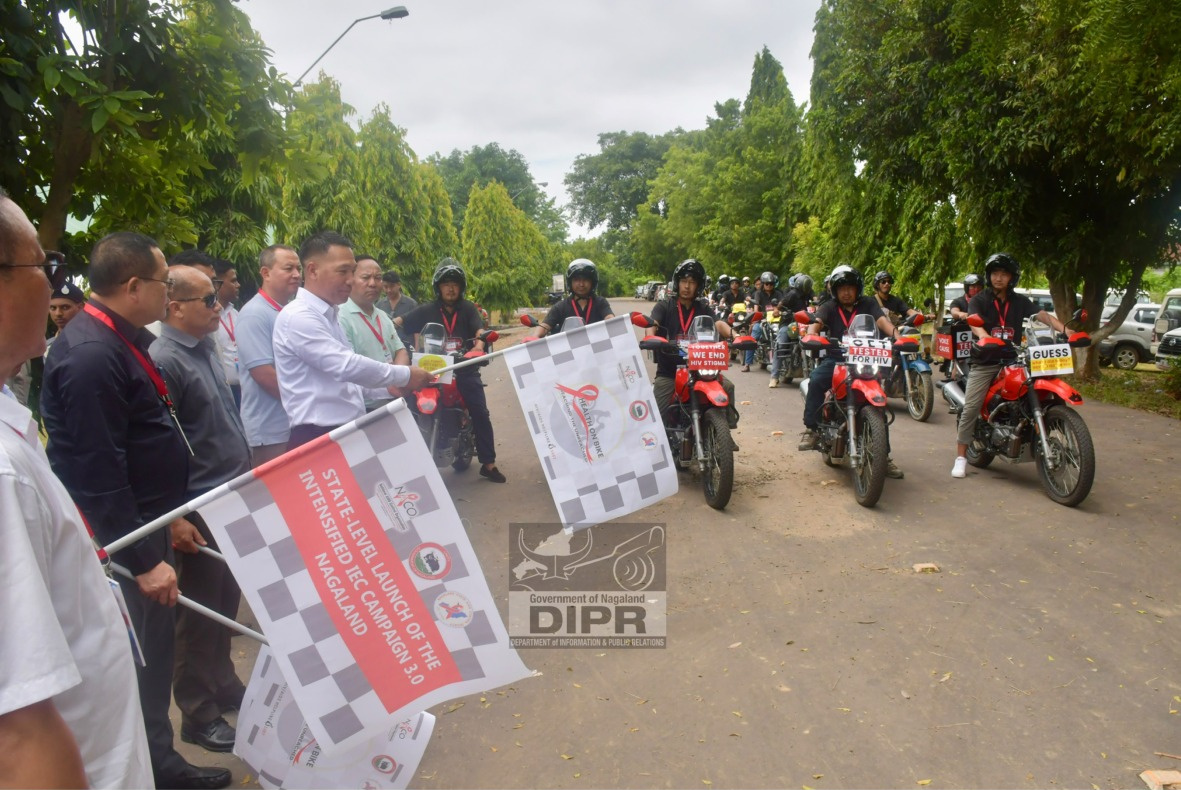
Following the programme, the Minister flagged off the Intensified IEC Campaign 2026 Bike Rally, with 25 bikers carrying messages of HIV and STI awareness, prevention and solidarity to communities. Five new Health on Bike outreach motorbikes were also flagged off to strengthen HIV-related services in Niuland, Tseminyu, Tuensang, Longchem in Mokokchung and Tobu in Mon districts.
Under the initiative, “Health on Bike – Reaching the Unreached,” the motorbikes would take HIV prevention, testing and related services closer to communities where difficult terrain and limited connectivity could restrict access to routine services. The programme was attended by senior Government and health officials, district administration, District Health Programme Officers, NGOs, teachers, students and community leaders.
(Samuel, IA Chumoukedima)


