
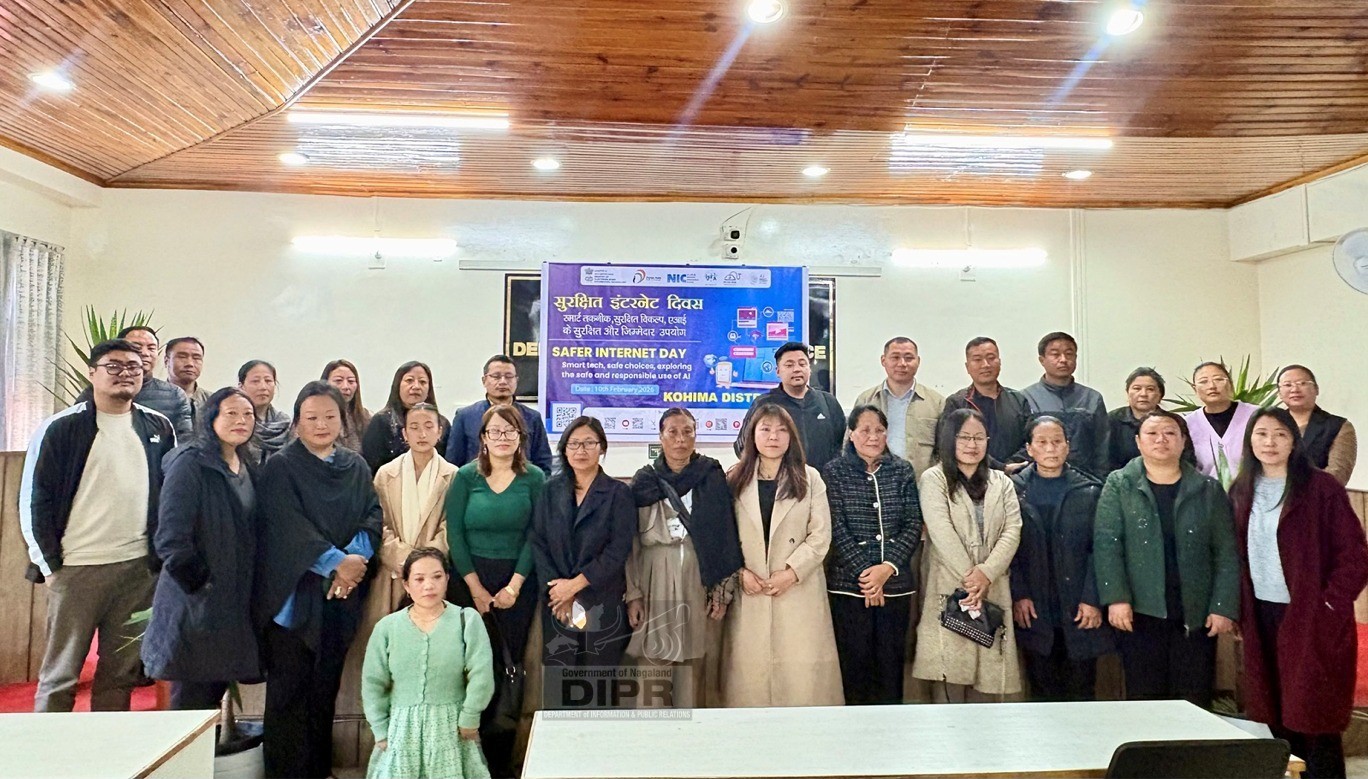
The National Informatics Centre (NIC), Kohima organised a district-level Awareness Campaign on the occasion of Safer Internet Day at the Conference Hall of the Deputy Commissioner’s Office, Kohima. The programme was organised with the theme “Smart Tech, Safe Choices – Exploring Safe and Responsible Use of AI.”
In her address, EAC Kohima, Imtiyenla K stated that Safer Internet Day is celebrated globally on the second Tuesday of February and highlighted the importance of the internet as a powerful tool that bridges communication enables access to information, education, healthcare and entrepreneurship. She cautioned that while the internet offers immense opportunities, it also harbours risks such as cyberbullying, misinformation, deepfakes and online fraud. She stressed that digital illiteracy remains a major challenge and underscored the need for proper training and responsible use of technology, especially artificial intelligence in daily life.
District Informatics Officer, NIC Kohima District Centre, Temsunaro, welcomed the participants and highlighted the growing number of cyber fraud cases, stating that scammers often exploit human greed and lack of awareness. She emphasised that the key focus of the campaign was to create awareness on safe, smart and responsible use of the internet and emerging technologies.
A detailed presentation was delivered by Sozenlo Tep, Network Field Engineer, NIC, who explained that Safer Internet Day is observed worldwide to sensitise users on safe and responsible use of the internet and AI, promote cyber hygiene practices, and educate users about major cyber threats and their mitigation. He informed that the Ministry of Electronics and Information Technology (MeitY) is observing a nationwide awareness campaign on 10th February 2026 under the aegis of the Information Security Education and Awareness (ISEA) Project, in collaboration with NIC and other agencies.
During the presentation, participants were briefed on the concept of the internet, its role in daily life, advantages and associated risks such as addiction, mental health issues, cyberbullying, misinformation, online scams and privacy concerns. Various cyber threats including phishing, OTP and UPI fraud, fake customer care scams, malware and spyware attacks, remote access scams, deepfake and AI voice frauds, social media account hacking, online shopping scams and digital arrest scams were explained in detail.
The resource person emphasised that no government agency arrests or investigates individuals through video or voice calls or demands money online, and urged participants not to panic and to verify information before acting. He highlighted the importance of cyber hygiene, use of strong and unique passwords, two-factor authentication, cautious use of public Wi-Fi, and installation of apps only from trusted sources.
The session also highlighted the positive role of artificial intelligence in healthcare, education, safety, efficiency, environment monitoring and digital services, while cautioning against misuse, privacy concerns, misinformation and bias. Participants were advised on fact-checking AI-generated content and responsible sharing of information online.
The programme concluded with information on reporting cybercrimes through the National Cyber Crime Helpline number 1930 or by filing complaints on the National Cyber Crime Reporting Portal at cybercrime.gov.in, or at the nearest police station.
(Molungnenla, IA, Kohima)


