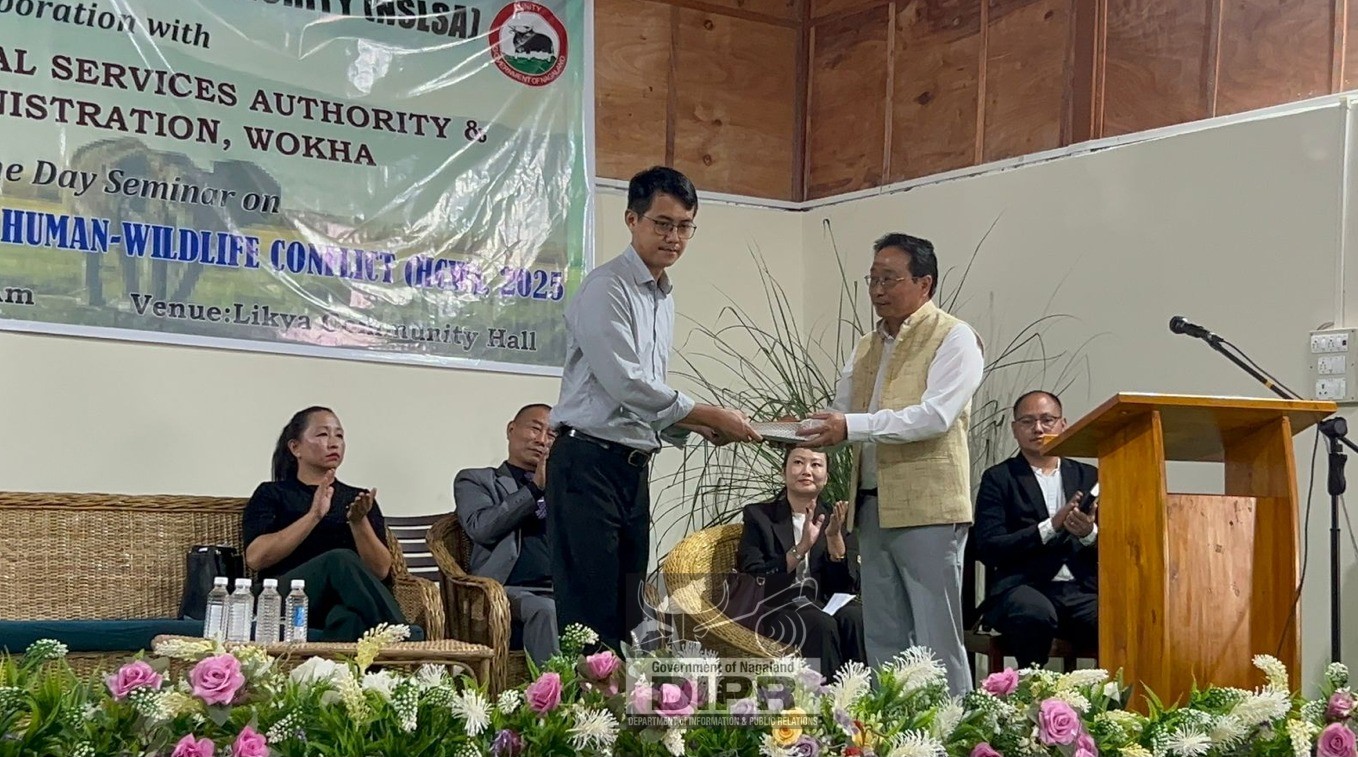
The Nagaland State Legal Services Authority (NSLSA), in collaboration with the Wokha District Legal Services Authority (WDLSA) and the District Administration, Wokha, organized a one-day seminar on “Access to Justice for Victims of Human-Wildlife Conflict (HWC)” at Likya Community Hall, Wokha on 30th May 2026. The seminar, attended by around 250 participants, sought to create awareness on legal rights, relief measures, compensation provisions, and access to justice for victims affected by incidents of human-wildlife conflict.
Deputy Commissioner Wokha, K. Mhathung Tsanglao, NCS, in his special address, highlighted the growing challenge of human-elephant conflict in the district, noting that elephant presence has been reported in over 100 villages, with nearly 60 villages identified as active conflict zones. He expressed concern over the destruction of paddy fields, areca nut and rubber plantations, farmhouses, and other agricultural properties, resulting in severe livelihood losses. He also pointed out that Wokha has recorded five human fatalities since 2018 due to human-elephant conflict, while Nagaland has reported around 15 elephant deaths. Stressing the urgent need for preventive measures and coordinated intervention, he distributed relief assistance to victims during the programme.
Assistant Manager (Relief, Recovery & Mitigation), NSDMA, L. Jonjibemo Odyuo, delivered a detailed presentation on relief measures in cases of human-elephant conflict, with special reference to Wokha district. He explained that wild animal-related disasters were recognized as State Local Specific Disasters in 2017, enabling relief assistance under the State Disaster Response Fund (SDRF). He clarified that relief is not compensation but minimal assistance to help victims cope with damages.
Presenting cumulative data from 2018 to 2026, Odyuo informed that 483 beneficiaries across 13 districts received Rs. 70,88,880 in relief assistance. Wokha district recorded the highest number of beneficiaries at 256, receiving Rs. 49,10,320, followed by Mokokchung with 165 beneficiaries receiving Rs. 12,35,580. Together, Wokha and Mokokchung accounted for Rs. 61,45,900, constituting 86.79 per cent of the total relief disbursed in Nagaland.
District-specific figures for Wokha included ex-gratia for deceased persons (4 beneficiaries, Rs. 16,00,000), ex-gratia for injured persons (2 beneficiaries, Rs. 20,000), kutcha house damage (27 beneficiaries, Rs. 18,70,600), agricultural crop damage (106 beneficiaries, Rs. 6,01,620), plantation damage (16 beneficiaries, Rs. 91,800), horticulture crop damage (15 beneficiaries, Rs. 88,200), hut damage (32 beneficiaries, Rs. 2,00,300), and hut with plantation or crop damage (54 beneficiaries, Rs. 4,37,800). He also noted that 150 bags of rice relief were recently provided to Old and New Changsu villages.
Member Secretary, NSLSA, Neikho Akami, explained the "Access to Justice for Victims of Human-Wildlife Conflict 2025” scheme, which provides legal assistance to victims in documentation, filing claims, and pursuing compensation. He emphasized that Wokha was chosen as the venue for the seminar as it records the highest incidence of human-elephant conflict in Nagaland, and assured that a dedicated team would assist victims with procedures related to compensation claims.
Wildlife Warden Dimapur, Dr. C. Zubeni Tsanglao, spoke on the importance of coexistence and conservation, stressing that Nagaland is part of a biodiversity hotspot. Referring to constitutional provisions and the Wildlife (Protection) Act, 1972, she emphasized that conservation is both a state and citizen responsibility. She explained that encroachment and blocked corridors have intensified conflicts, urging compassion, awareness, and timely reporting of incidents.
The seminar concluded with an interactive session where victims and village council members raised concerns and shared grievances, while officials assured that lessons learned would contribute to more effective implementation of future programmes.
(DPRO and IA, Wokha)