
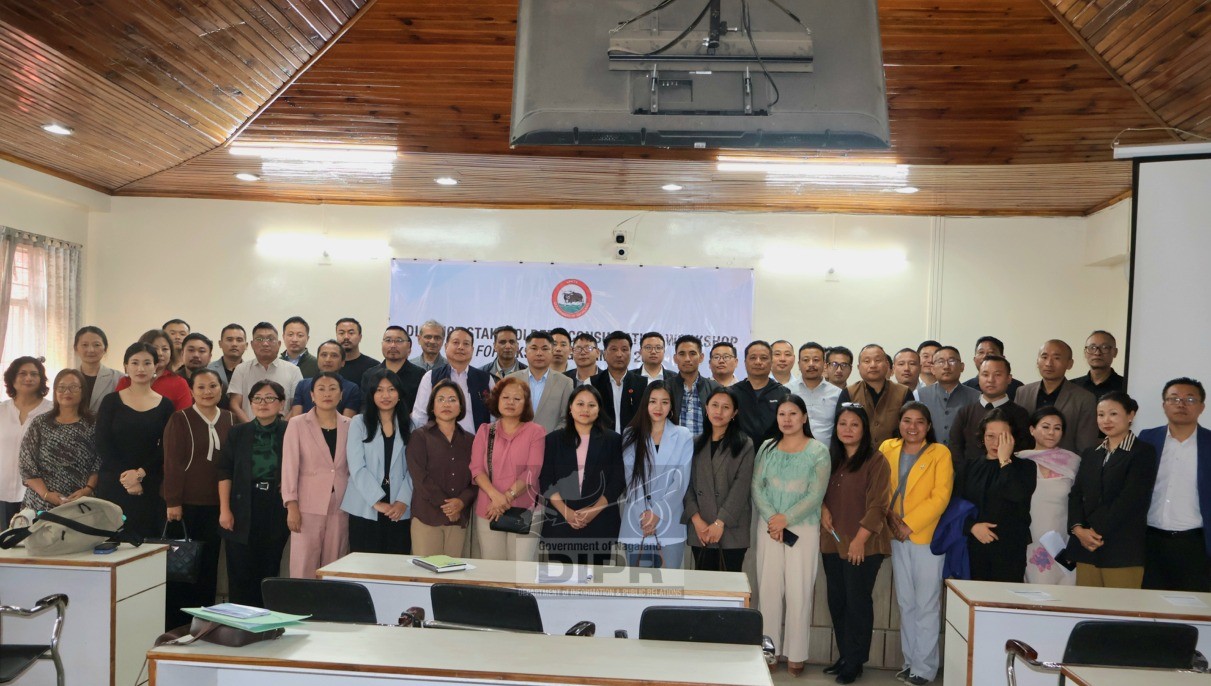
A District Stakeholders’ Consultation Workshop on Viksit Nagaland@2047 was held at the DC’s Conference Hall, Kohima on 21st April 2026, with the objective of capturing inclusive, multi-sectoral perspectives, identifying systemic gaps, and setting visionary targets for 2030, 2038 and 2047.
The workshop brought together representatives from government departments, civil society organisations, and other stakeholders on a common platform to deliberate on the vision for a developed Nagaland aligned with national goals.
Delivering the welcome address, Deputy Commissioner, Kohima, B. Henok Buchem, NCS appreciated the presence and active participation of stakeholders, stating that the seriousness reflected in the gathering was encouraging. He highlighted that developed nations undertake long-term planning well in advance, often spanning several years, and noted that India’s vision for 2047 similarly calls for sustained and collective effort.
He stated that the consultation process is a coordinated exercise aimed not only at data collection but at enabling structural and governance reforms. The outcome, he said, would contribute to the preparation of a comprehensive Vision Document aligning district and state aspirations with national priorities, including the Sustainable Development Goals (SDGs).
The DC informed that the planning framework has been structured into short, medium and long-term timelines to ensure systematic implementation and monitoring. He added that the district-level consultation aims to identify baseline indicators, prioritise key sectors, and set realistic and achievable targets for future development.
He further informed that deliberations would be carried out through five thematic working groups covering economic development, social development, infrastructure, environmental sustainability, and governance and institutional strengthening. The exercise, he said, seeks to incorporate inputs from all stakeholders, identify local challenges and opportunities, and develop district-specific recommendations.
Emphasising the importance of coordinated effort, he expressed confidence in the district administration’s capacity to deliver outcomes, citing past instances of successful teamwork under time constraints. He urged participants to take ownership of the process and ensure that local aspirations are effectively aligned with broader national goals. He also encouraged striving for improved performance under SDG indicators, stating that higher outcomes are achievable through collective commitment.
An overview of sectoral assessments was presented by various district line departments. The Department of Planning & Transformation highlighted that the Viksit Bharat initiative envisions India as a developed nation by 2047 and that states have been urged to formulate their respective vision documents through stakeholder consultations. It was informed that Nagaland had earlier articulated its SDG Vision 2030, and the present exercise seeks to co-create the Nagaland Vision 2047 by incorporating district-level aspirations.
The department outlined the consultation process, including identification of priority areas, formation of sectoral working groups, district consultations, and subsequent review and validation leading to finalisation of the Vision document. The objectives include understanding diverse stakeholder perspectives, conducting sectoral assessments, and ensuring that the needs of vulnerable groups are addressed in line with the “Leave No One Behind” principle.
During the session, various departments presented key schemes, achievements and challenges. The Chief Minister’s Micro Finance Initiative (CMMFI) highlighted improvements through digital onboarding and streamlined processes, alongside new interventions such as digital livestock insurance, vehicle subsidies, and Swavalamban Kendras for applicant facilitation.
The District Urban Development Agency presented the PM Street Vendor’s Atma Nirbhar Nidhi (PM SVANidhi) scheme, aimed at providing affordable working capital loans, promoting digital transactions, and enhancing financial inclusion among street vendors. Challenges highlighted included lack of designated vending zones, inadequate infrastructure, and increasing demand for vending spaces.
The District Industries Centre presented the PM Vishwakarma Scheme, which focuses on skill upgradation, toolkit incentives, concessional credit support, and market linkages for traditional artisans. Progress of training programmes and onboarding of artisans onto e-commerce platforms were also shared.
The Social Welfare Department presented the implementation of Saksham Anganwadi and Poshan 2.0, detailing service delivery mechanisms and beneficiary coverage across the district. The Chief Medical Office highlighted the implementation of Ayushman Bharat PM-JAY and CMHIS, noting improvements in health coverage while pointing out challenges in card issuance due to documentation gaps and connectivity issues.
The Power Department presented initiatives under the PM Surya Ghar: Muft Bijli Yojana and the Nagaland Solar Mission, aimed at promoting rooftop solar installations, reducing electricity costs, and advancing green energy adoption.
Following the presentations, participants were divided into five thematic groups for breakout discussions. The groups deliberated on key questions including past achievements and gaps, strategic priorities and growth drivers, and the extent to which the needs of marginalised and remote populations are being addressed.
In the plenary session, each group presented summaries of their discussions, including proposed interventions and policy recommendations. An open forum was also held to invite additional inputs from civil society participants.
The programme concluded with a vote of thanks and a briefing on the next steps for compilation of the district report based on the outcomes of the consultation.
(Molungnenla, IA)


