
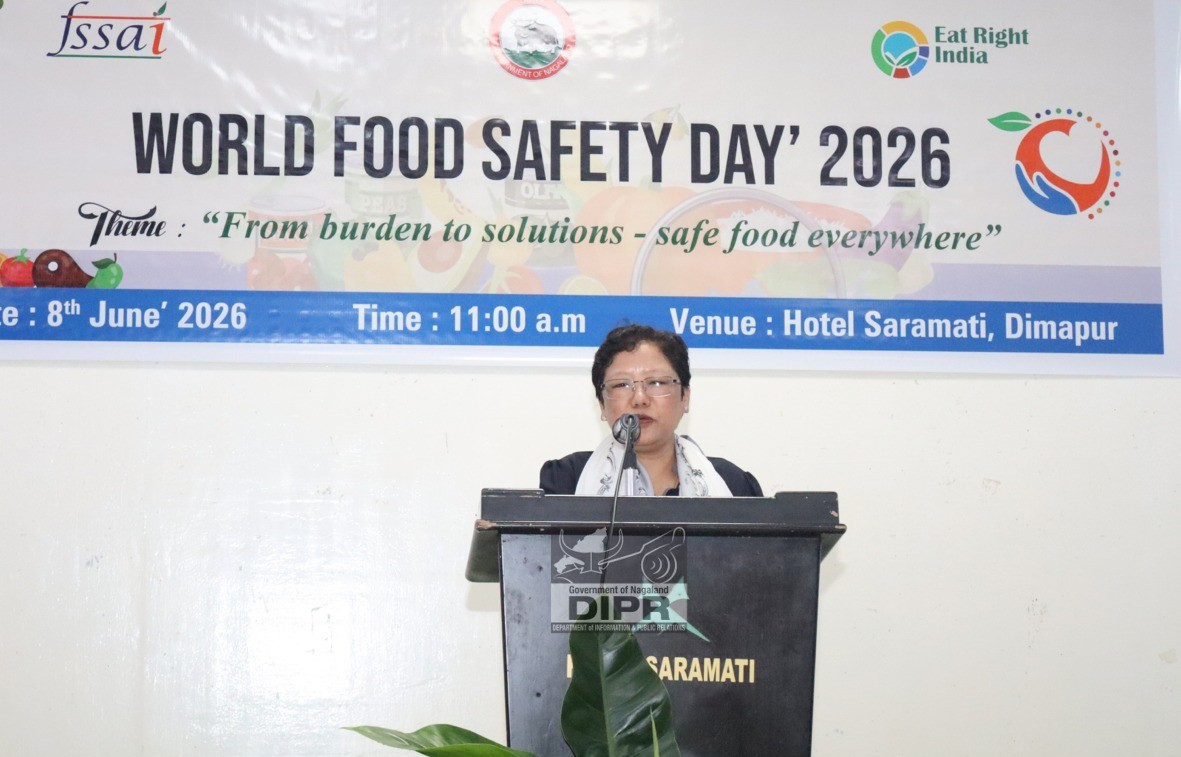
The 8th World Food Safety Day 2026 was observed at Hotel Saramati, Dimapur on June 8 under the theme, “From Burden to Solutions – Safe Food Everywhere.” The programme was organised by the Food Safety Wing under the Department of Health & Family Welfare, Government of Nagaland, in collaboration with the Food Safety and Standards Authority of India (FSSAI) and Eat Right India.
S. Tainiu, Secretary, Health & Family Welfare, Government of Nagaland, attended the programme as the special guest and delivered the keynote address highlighted the significance of World Food Safety Day in raising awareness about the importance of safe food and the collective responsibility of ensuring food safety from production to consumption. She stated that food is essential for sustaining life, nourishing the body, and enabling individuals to function effectively in their daily activities. However, unsafe and contaminated food can lead to serious health consequences, including food-borne diseases, hospitalisation, and even death.
Referring to global estimates, she noted that millions of people fall ill every year due to contaminated food, with children under the age of five among the most vulnerable groups. She said food safety is not only a health issue but also a social and economic concern, as food-borne illnesses place a heavy burden on families, communities, healthcare systems, and businesses.
Tainiu stressed that hotel owners, food handlers, and hospitality establishments have a crucial role in maintaining food safety standards. She emphasized the need for proper hygiene and sanitation in kitchens and dining areas, regular training of food handlers, safe sourcing of food products, correct storage practices, and adherence to food safety regulations.
She further called for greater awareness regarding food allergens, urging food establishments to clearly identify allergen-containing foods and train staff to respond appropriately to customers with dietary restrictions and allergy concerns. She also stressed the importance of having emergency response mechanisms in place to address food complaints, suspected food poisoning incidents, and product recalls promptly and effectively.
She urged all stakeholders, including government agencies, food business operators, hoteliers, and consumers, to work together in promoting a culture of food safety. She stated that ensuring safe food is a shared responsibility and that commitment to food safety contributes to better public health outcomes, consumer confidence, and the sustainable growth of the hospitality and food service sectors. She encouraged participants to become advocates of food safety and to apply safe food practices in their homes, workplaces.
A presentation on the theme, “From Burden to Solutions – Safe Food Everywhere,” was delivered by Dr. John Kemp, State Programme Officer & Food Safety (DHFW). He stated that food safety is a shared responsibility involving everyone in the food chain—from producers and transporters to retailers, food inspectors, cooks, and consumers. He noted that data and scientific evidence play a crucial role in identifying food safety risks and developing effective solutions to reduce foodborne diseases. Dr. Kemp also stressed the need for strengthening food safety surveillance systems, promoting science-based decision-making, improving traceability across the food supply chain, and enhancing public awareness to ensure safe and nutritious food for all. He urged all stakeholders to work together in adopting safe food practices and building a healthier society.
Vikie Nagi, Secretary Finance, Nagaland Hotel & Restaurant Association, in his short speech, said that food safety is the invisible backbone of the tourism and hospitality industry, and that the hotel industry plays a vital role in public health by serving millions of meals daily. He noted that the theme of World Food Safety Day 2026, “Food Safety, Everyone’s Business,” highlights the collective responsibility of all stakeholders involved in the food chain—from production and processing to transportation, storage, preparation, serving and consumption. He emphasized that every department in a hotel has a role to play in ensuring food safety and maintaining guests’ trust. Nagi further assured the Nagaland Hotel and Restaurant Association’s long-term cooperation with the Health & Family Welfare Department in promoting safe food practices and improving public health.
After the formal programme, a hands-on training session was conducted for hoteliers and stakeholders. Food Technicians provided practical demonstrations and awareness on clean hands, food adulteration, and food contamination. Speaking on the theme “Safe Food Begins with Clean Hands,” they emphasized the importance of proper hand hygiene and safe food-handling practices in preventing foodborne illnesses and ensuring food safety.
The programme was chaired by PelerienoKehie, Designated Officer, Dimapur Zone, while the invocation was offered by Zuthungbemo K. Ngullie, Food Technician. The vote of thanks was proposed by KhrukutoluVeswuh, Deputy Director (Food Analyst), State Public Health Laboratory, Nagaland.
(I.Tiakumla Ao, IA Dimapur)


