

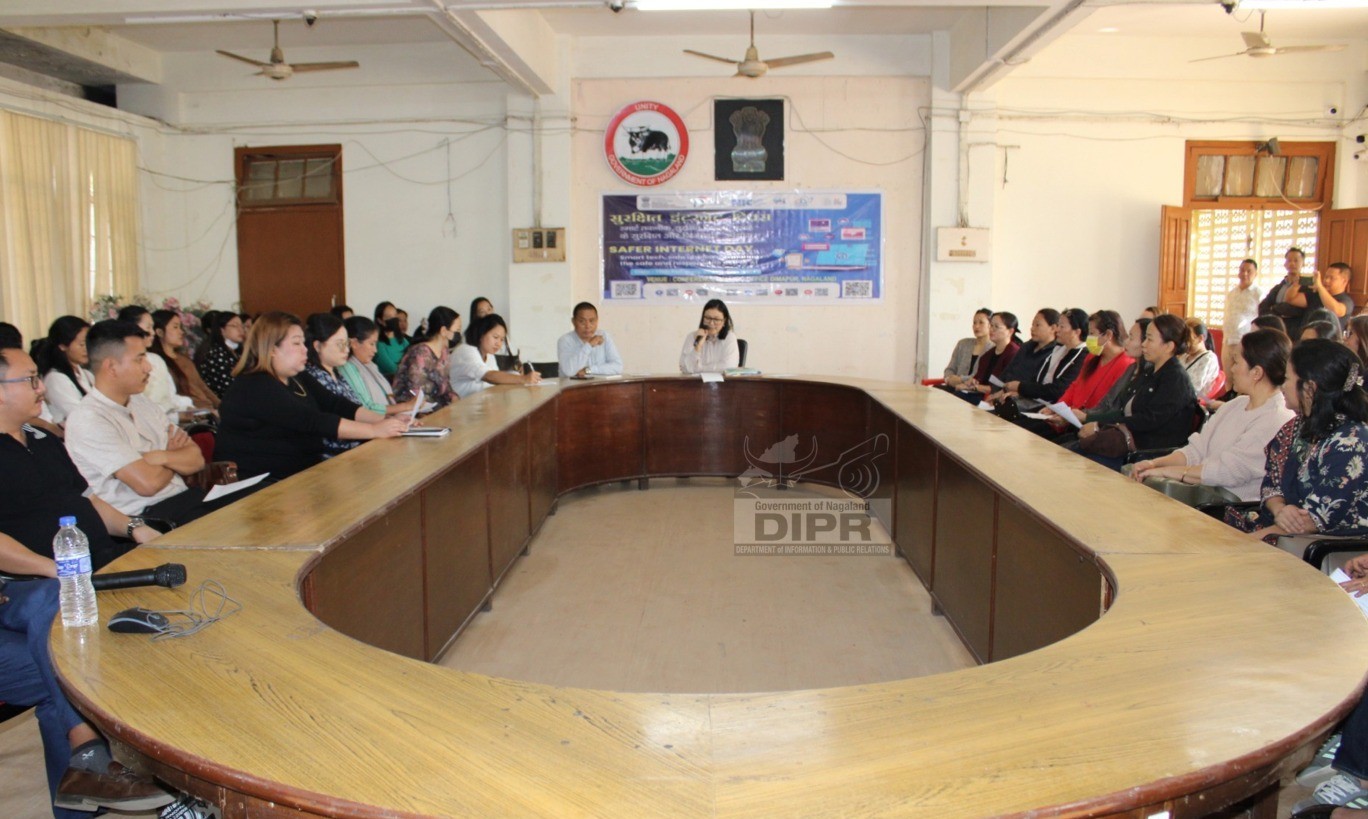
With the observance of Safer Internet Day 2026, the Office of the Deputy Commissioner, Dimapur organized a district-level awareness programme and workshop focusing on the safe and responsible use of the internet and artificial intelligence (AI) on 10th February 2026 at DC’s Conference Hall, Dimapur.
The programme is being organized in line with the initiative of the Ministry of Electronics and Information Technology (MeitY), Government of India under the theme “Smart Tech, Safe Choices – Exploring the Safe and Responsible Use of AI.” Safer Internet Day is observed globally on the second Tuesday of February every year to raise awareness on safe and responsible internet use, particularly among children, women, and young people. The campaign aims to educate users on safe online practices, cyber hygiene, major cyber threats, and mitigation strategies, while promoting responsible use of internet and AI technologies.
ADIO (NIC), Dimapur, Kamal Chetri in his introductory remarks said that under the theme “Smart Technology, Safe Choices”, the programme aimed at promoting the safe and responsible use of Artificial Intelligence (AI). He stated that AI has become an integral part of daily life, influencing activities such as online shopping, video recommendations, advertisements and learning platforms.
He informed that Internet Day is observed every year in February on the first Tuesday, with this year’s observance focusing on women, youth and workplaces. While highlighting the benefits of AI, he cautioned about the growing risks of misuse, noting that AI-generated fake videos and voice calls have made it difficult to distinguish between real and fake content. Emphasising ethical use, he urged participants to protect personal data and stressed that despite technological advancements, human judgment remains essential.
EAC (Dev), Dimapur, Imlijungla Lemtur, in her keynote address said that under the theme “Smart Technology, Safe Choices”, the programme focused on promoting the safe, confident, and responsible use of Artificial Intelligence (AI). She highlighted that AI, under the sphere of electronics and information technology, has rapidly become an integral part of everyday life and is now present in almost every aspect of human activity. While pointing out the immense benefits of AI, she cautioned that the risks associated with its misuse are equally significant. She noted that it has become increasingly difficult to distinguish between real and fake content, including videos and voice calls, as AI can now replicate human voices and create highly realistic fake media. She also mentioned that even music and tunes are now being generated using AI technology.
Lemtur stressed the need to leverage AI responsibly, stating that basic knowledge of AI tools can help improve efficiency and save time in the workplace. However, she cautioned against replacing human judgment and critical thinking with technology. She urged participants to remain mindful of the personal and sensitive data they share online, reiterating that technology must always be guided by ethical and responsible use. She concluded by emphasising that despite technological advancements, human judgment remains crucial.
PowerPoint presentation was presented by ADIO (NIC), Chumoukedima, Vicky Kumar Sharma, & DIA (NIC), Dimapur, T. Thongtsali Sangtam, where they highlighted various aspects of exploring the safe and responsible use of safer tech. The session focused on phishing attempts carried out through SMS, email and WhatsApp, warning users against fake messages that appear official and urge recipients to click on suspicious links. The participants were informed that the primary objective of phishing attacks is to steal sensitive information such as passwords, banking credentials and card details. Common warning signs highlighted included urgent or threatening language, unfamiliar links and spelling or grammatical errors in messages. Citizens were advised to verify information only through official websites or applications and avoid clicking on unknown links.
During the presentation, it also showcased the Government of India’s Sanchar Saathi portal, a citizen-centric platform offering services such as reporting suspected fraud communications, blocking lost or stolen mobile phones, verifying mobile connections, and checking international incoming calls with Indian numbers. Participants were further informed about the mechanisms available to report cybercrime. Victims or suspected cases can register complaints by calling the national cybercrime helpline number 1930, filing complaints online through www.cybercrime.gov.in, or approaching the nearest police station.
The program concluded with a pledge and an awareness initiative emphasizing the importance of digital vigilance, encouraging citizens to stay informed and proactive to protect themselves against cyber threats.
(Tovikali, IA, Dimapur)


