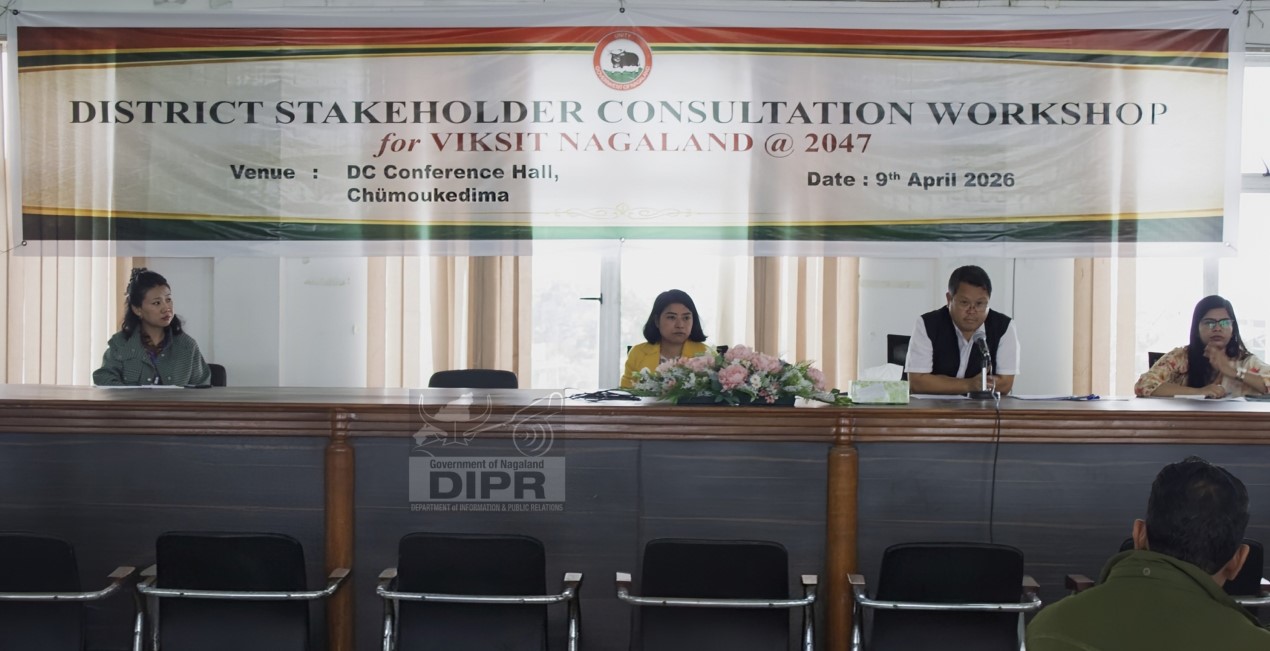
The Office of the Deputy Commissioner, Chumoukedima organized a District Stakeholder Consultative Workshop for ‘Viksit Nagaland @2047’ on April 9, 2026 at the DC’s Conference Hall. The consultation is part of a wider initiative to develop a long-term vision document for the state through inputs from stakeholders at all levels.
Presiding over the inaugural session, Deputy Commissioner, Chumoukedima, Polan John, NCS delivered the welcome address and provided a comprehensive overview of the 'Viksit Nagaland @ 2047' vision, stating that it aims to create a comprehensive roadmap for the development of Nagaland by the time India marks 100 years of independence.
He said that the workshop is being conducted as part of an ongoing effort to prepare a holistic and inclusive vision document for the state’s development by 2047. He highlighted that the objectives of the consultation include understanding diverse stakeholder perspectives, conducting sectoral assessments, identifying critical issues and bottlenecks, and ensuring that the needs of vulnerable groups are addressed in line with the principle of “leaving no one behind.”
The DC informed that the discussions would focus on five thematic pillars—economic development, social development, environmental sustainability, infrastructure development, and governance and institutional strengthening.
He urged participants to come prepared with relevant data, case studies, and structured inputs, particularly reflecting on sectoral developments over the past decade. He emphasized the importance of reviewing key changes, identifying limiting factors, and highlighting areas where progress has been lacking, in order to generate meaningful insights on sectoral trends, challenges, and opportunities.
He also welcomed the team from the Nagaland Institute of Transformation (NIoT) and acknowledged their pivotal role in conducting the workshop. He noted that NIoT, under the Department of Planning and Transformation, is the state’s premier think tank, supported by NITI Aayog under its State Support Mission. He added that the institute serves as a knowledge hub for strategic planning and policy innovation, promoting evidence-based policymaking while aligning the state’s developmental priorities with national goals.
He welcomed all participants and urged them to actively engage in the discussions and provide constructive feedback so that the outcomes of the workshop truly reflect the ground realities of the district.
During the sectoral assessment session, various district departments including Medical, Social Welfare, Agriculture, PHED, Power, Forest, Employment & Skill Development, and Industries & Commerce presented detailed updates on their respective activities. The presentations focused on five strategic pillars: economic growth, social development, environmental sustainability, infrastructure, and governance. Furthermore, the departments highlighted the progress and implementation status of various flagship schemes currently being executed across Chumoukedima district.
The technical session also included Interactive group discussions, where participants deliberated on challenges and opportunities within their respective sectors. The outcomes of these discussions were later presented, highlighting sector-specific priorities and recommendations.
The workshop concluded with the closing remarks delivered by SDO (C) HQ, Shreyansee Jain, IAS. The day-long workshop brought together various district line departments and public sector undertakings, frontline service providers, NGOs, and community representatives to deliberate on a transformative development roadmap.
(Samuel IA Chumoukedima)


