

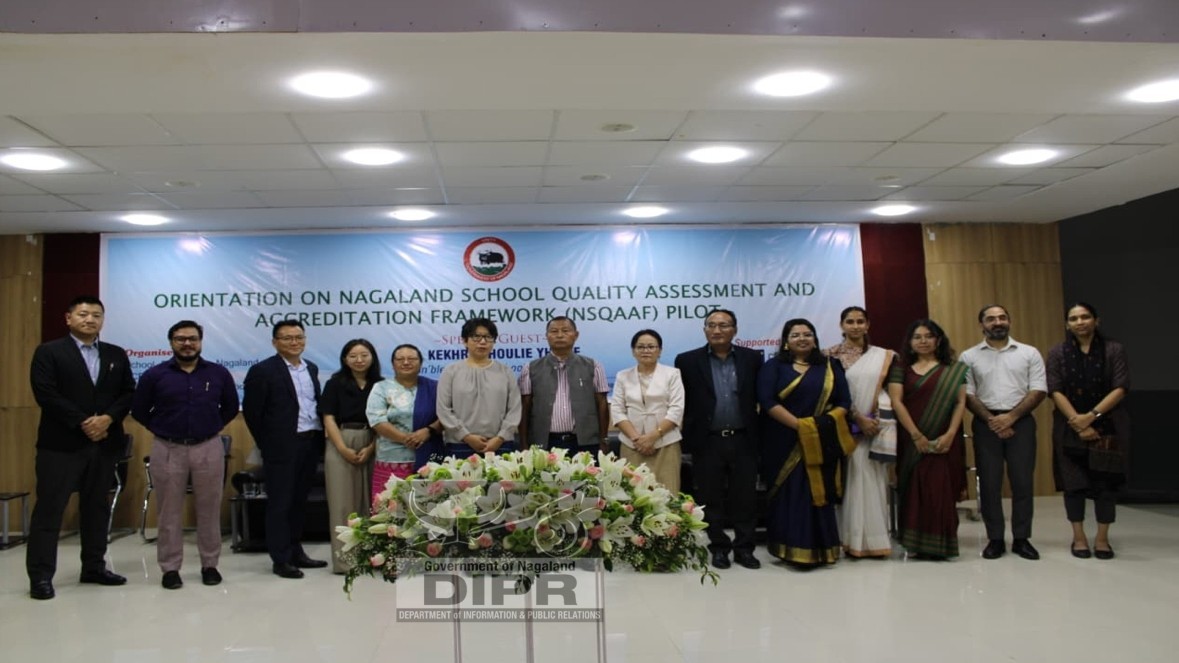
A one-day Orientation on Nagaland School Quality Assessment and Accreditation Framework (NSQAAF) Pilot programme with Head of Institutions/Proprietors of 100 selected schools and 90 selected external evaluators and supported by Central Square Foundation was held at the Capital Convention Centre, Kohima on 19th June 2026.
Advisor for School Education, Dr. Kekhrielhoulie Yhome, in his speech spoke on the importance of the NSQAAF in bringing positive changes to Nagaland’s education system as the new framework will help schools understand their strengths and areas for growth through a structured assessment across five key domains which are administration, curriculum, assessments, infrastructure, and inclusiveness, to encouraged schools to see the pilot as an opportunity to improve and work towards better standards in shaping a stronger and a brighter future for education in the state.
He informed that the NSQAAF is represented by 100 selected schools from the both private and government sector and pointed out that Nagaland having roughly 1900 government schools and 880 private schools and a dozen of central schools has about 34,000 teachers in both the private and government sector, with a ratio of one teacher for every 12 students. He also shared that our state have many confronting issues such as schools with zero students or very less students and to clearing these issues, many government schools have to be amalgamation, but in response to give children the ‘Right to Education’, many schools are also being opened and regulated and re-authoring the school system.
Commissioner & Secretary, School Education and Chairperson of Interim NSSSA, Kevileno Angami in her speech, highlighted that the NSQAAF was a proposal for
Additional Secretary, Department of School Education and SCERT, Vikhweno Chale, while highlighting on the Introduction to NSQAAF, NSSSA and the Pilot, stated that the NSQAAF Schools of Planning and Architecture (SPA) and National Education Policy (NEP) 2020 introduced a tagging shift in how school quality compliance and accreditation has to be managed and how the framework prioritize learning outcomes, transparency and self-assessment by following the National Assessment Program (NAP) developed by the NCERT in collaboration with various stakeholders. She said this framework has been adapted under the Ministry of Education that will be used to assess the performance of our schools, having five domains, 53 sub domains and 338 standards, and each group has to perform those criteria, standards as this standard setting is to provide a health check-up of overall education system which contains essential quality standards.
She also mentioned that each domain is assigned with three levels that will apply from preschool to class 12 and the Nagaland State School Standards Authority response to maintain minimum quality and professional standards. She also asked parents not to judged schools based on hearsay but informed that with the framework, one can have access to reliable information about the quality of schools, as NAP 2020 has set a correction technique for the school system namely self-assessment for continuous improvement, transparency and accountable and called upon the schools to contextualize this framework with honesty and sincerity while responding to this pilot so as to develop a good framework.
Director SCERT and Member NSSSA, Keruupfeu Rupreo in her welcome address said to strengthen the quality of school education in Nagaland and to provide every child with meaningful, inclusive and high-quality learning opportunities, she stressed that NSQAAF has been developed as a framework to help schools reflect on their practices, identify their trends, and recognize areas of growth designed not as a tool for judgment, but as a tool for continuous learning improvement to encourage schools to engage in all self-reflection to the journey towards excellence. She also encouraged the participants to seek clarification and engage in discussions as their inputs will be crucial in shaping framework so as to serve the needs of schools and learners.
The programme was chaired by Under Secretary, Department of School Education, while the vote of thanks was proposed by NBSE Secretary and Member Secretary, Interim NSSSA, Rangumbuing Nsarangbe. The resource persons for the orientation programme were Niharika Suresh, Prasuti Sharma and Zephyr Pegu from the Central Square Foundation.
(Maongtemjen, IA)


